3.
🔴 AI-EXPOSED | Score 35-50
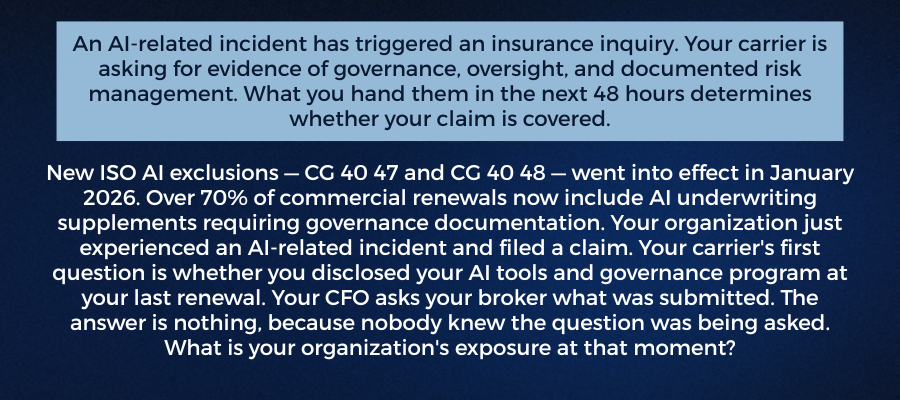
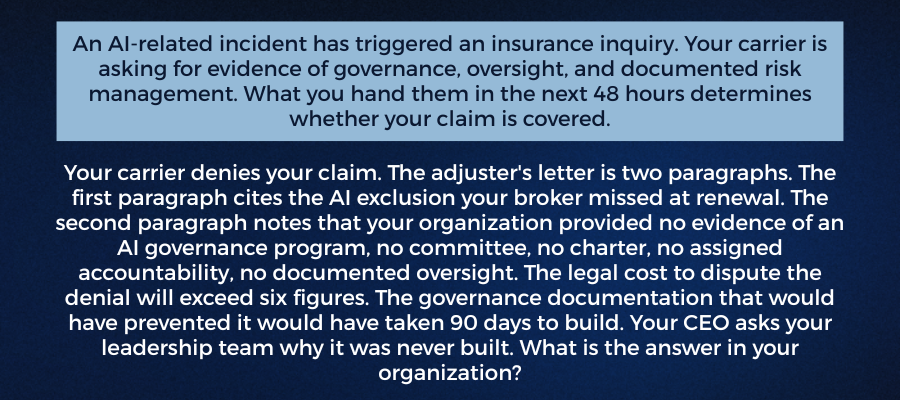
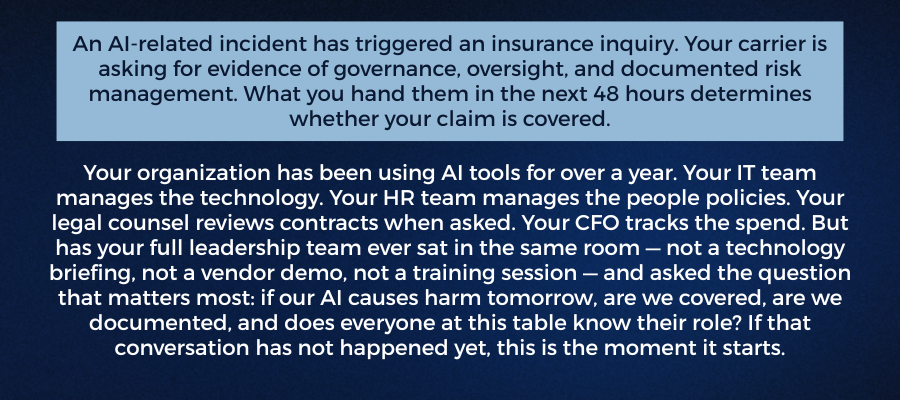
🔴 Your Organization Is AI-ExposedYour score reflects significant AI exposure and limited documentation to defend it. That is not a technology failure. It is a governance gap that sits at the leadership level. The fact that you completed this assessment means you already suspected this. Now you have confirmation — and confirmation is the first step toward protection.This is urgent. But it is fixable⚠️ BEFORE YOU READ YOUR RESULT — THIS APPLIES TO EVERY SCOREEven if your organization has strong AI practices, aware leadership, and capable teams — if those practices are not formally documented, your insurance carrier cannot see them. Undocumented governance is invisible governance. At renewal, at audit, and at the moment of a claim, the only thing that protects your organization is what exists on paper. Informal does not equal insurable.AI governance is not a once-a-year compliance exercise. Unlike an annual audit or a policy renewal, AI governance is a living program. Your AI tools change. Your vendors update their terms. New regulations take effect. New features get pushed to your platforms without notice. A governance program that was accurate six months ago may already have gaps today.AI governance is not covered by your cybersecurity program. If your organization has SOC 2 certification, cyber liability insurance, or an IT security framework — that is valuable. It does not cover AI governance. SOC 2 was not designed for AI. It does not address bias detection, model drift, human-in-the-loop requirements, AI acceptable use policy, or workforce AI decisions. Your cyber carrier and your AI exposure are two completely separate conversations. Most organizations do not know this until they file a claim.🔴 YOUR RESULT — AI-ExposedYour organization is carrying significant AI exposure right now. ISO AI exclusions CG 40 47 and CG 40 48 went into effect in January 2026. Over 70% of commercial renewals now include AI underwriting supplements requiring governance documentation. Organizations that cannot produce a governance program are facing denied claims, 20 to 50% premium surcharges, and personal D&O exposure for the executives who knew the risk existed and did not act.Your economic reality: the legal cost to dispute a denied AI-related claim routinely exceeds six figures. The governance infrastructure that would have prevented it typically takes 90 days to build from zero. A charter, a committee structure, an acceptable use policy, a vendor contract checklist, an incident response protocol — these are buildable documents with a defined scope and a defined timeline.You do not have a technology problem. You have a leadership urgency problem. And the most expensive version of this situation is the one where the incident happens before the documentation exists.⚠️ THE DOCUMENTATION REALITYIf your insurance carrier called today and asked for your AI governance documentation — your committee structure, your acceptable use policy, your AI systems inventory, your incident response protocol, your human oversight trail — what would you hand them?Strong practices that live in people's heads do not protect your organization. Informal agreements about who owns what do not satisfy an underwriter. The organizations that are AI-insurable are the ones that have built the paper trail that proves their governance program exists.Your next step is an urgent conversation about what your organization is actually exposed to right now and how to build the governance infrastructure that protects you before the next renewal — or the next incident.