4.
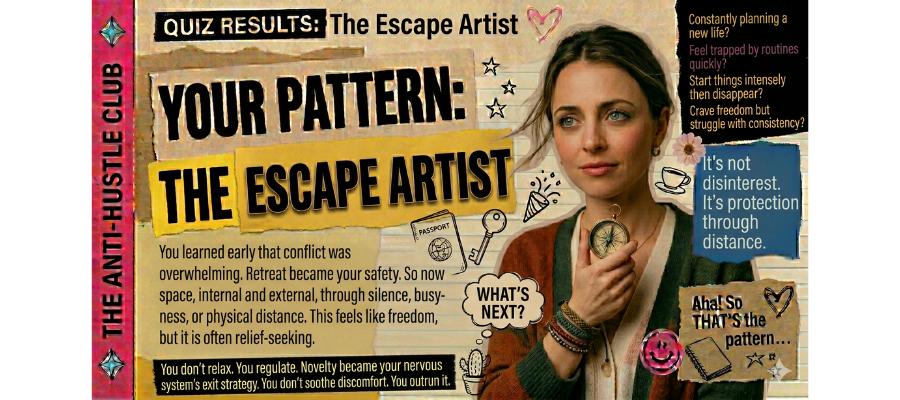
The Escape Artist
THE ESCAPE ARTISTYou're not afraid of commitment. You're afraid of what happens when the exit is blocked and things get uncomfortable and you have nowhere to go.You are, at the beginning of things, magnificent. The new project, the new city, the new relationship, the new plan that is going to be different from the last plan, you bring everything to it, all the energy and the vision and the absolute certainty that this is the one that's going to stick. And for a while it does. For a while the novelty is doing its job, which is keeping everything feeling alive and possible and not yet disappointing, and you are in your element, which is the phase before the phase where things get complicated.And then things get complicated. Not necessarily dramatically, just in the ordinary way that things do when the shine has come off and the reality has set in and what's required now is not inspiration but the duller, less glamorous business of staying. And somewhere in your body, before your brain has even fully registered it, the familiar restlessness starts. The feeling that something isn't quite right here, that maybe this isn't the thing after all, that the problem isn't that you need to push through but that you've been paying attention to a sign that other people keep telling you to ignore. And maybe that's true. Or maybe, and you've had this thought yourself in the smaller hours, the restlessness is the exit strategy, not the signal.The relentless forward motion is the thing that looks most like freedom from the outside and feels most like freedom from the inside, right up until the moment you realise you've been outrunning something for so long you can't remember what it was anymore. You don't soothe discomfort, you outrun it, which works brilliantly as a short-term strategy and has some complicated long-term side effects, not least of which is that you've become dependent on the forward motion itself, the planning, the next thing, the new start, the what if we just, in a way that makes the absence of it feel uncomfortably like being trapped.You became this because at some point stillness stopped feeling safe and movement started feeling like control. Maybe the environment you grew up in required strategic exits. Maybe the thing you were supposed to stay in was something you were right to leave, and you learned from that, correctly, that leaving was sometimes the bravest option, and then that lesson got a little over-applied. Either way, you learned that you could regulate almost anything with enough novelty, and your nervous system became an enthusiastic student of that particular lesson and has been faithfully applying it in situations where it doesn't always serve you.The thing the Escape Artist tends to find, eventually, is that the life she's been running toward and the life she's been running from have started to look remarkably similar, because she's the common denominator, and you can't outrun yourself across county lines, or time zones, which some of us have tested fairly thoroughly.What you haven't fully tried yet is staying through the uncomfortable bit and finding out what's on the other side of it. Not because you can't. But because the exit has always appeared before you've had to.You stayed present long enough to finish this quiz, which is, for the Escape Artist, more significant than it sounds.That's the part we're interested in now.