
If you’ve decided that 2026 is the year to add email marketing into your business, this is the guide for you. My name is Josh Haynam, I’m the co-founder of Interact, a software for creating list building quizzes that people have been using since 2013. We have helped over 10,000 businesses add more than 100 million email subscribers to their lists using our tool. I have seen every iteration of email list growth, most of which are terrible and only result in pain for everyone involved.
However, there are a general set of principles for building an email list and using email marketing to drive revenue. These principles are what I have observed from the top creator-led businesses over the last 13 years. The people I’ve gotten to talk to have collectively made 100’s of millions of dollars through email marketing, and this guide is a generalized observation of what they all have in common. Let’s get into it.
Step 1: Choose an email software
I’ve been recommending email software for a long time and there are a few recommendations that always make people happy.
- Flodesk: If you want the best looking emails
- Kit: If you want the most advanced automations
- Klaviyo: If you run an E-Commerce store
These three options won’t steer you wrong, they all have all the features you’ll need, and are easy to use with great teams to support you with any help needed.
Step 2: Write your welcome email
Before you ask anyone to join your email list, you want a welcome email ready to go. This email introduces the new subscriber to your list. But more importantly, it informs them about what value they will get by being on your email list. This is the first and greatest mistake most people make with email. They assume “great, someone joined my email list, time to start spamming them with sales offers!” and that’s rubbish.
Your welcome email, just like the rest of your emails, are about adding value to the subscriber. Of course, your products and offers will be mentioned in your emails, because they are part of how you add value. But honestly if I had a dollar for every business I’ve seen where all of their emails are sales emails all of the time, I’d be retired ten times already.
The best welcome emails I’ve ever seen are the ones where the person introduces themselves in the context of how they can be helpful to their new subscriber, then continues on with helpful information for the new subscriber. The best welcome emails are also personality-laden, full of life and uniqueness. In 2026 people are so tired of general and generic, if they are going to stop and read your email it’s got to be from you, not a ChatGPT garbage slop output.
Step 3: Write a weekly newsletter
Even if you have six subscribers, commit to writing a weekly newsletter. This practice is vital, especially if you haven’t done email marketing before. You’ll develop your voice, get a sense for what people actually respond to and read, and generally improve. The best newsletters are the ones people have been sending for years. A few examples if you want some inspiration are Jen from Tonic Site Shop, Erin from Advice with Erin, and Jamie Sea. Each of those newsletters has a unique voice and you can tell when you join that they’ve been practicing for years and years because the writing is unique, helpful, and full of personality.
Step 4: Create lead magnets
Lead magnets are offers you can trade people in exchange for them joining your email list. In 2026 the best lead magnets are.
- Quizzes: People find their quiz result in exchange for their email
- Guides: People get your guide in exchange for their email
- Webinars: People join your webinar in exchange for their email
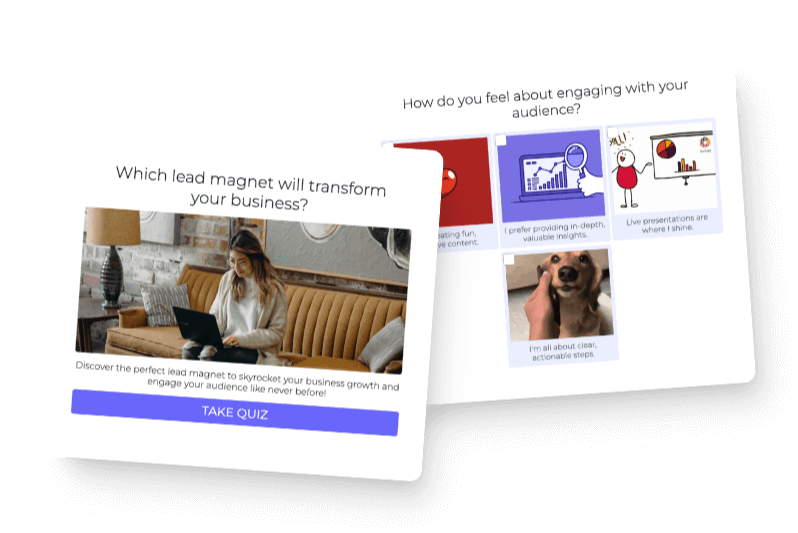
Quizzes are the top lead magnet because they are fun and work perfectly with social content. For example, Erin from Advice With Erin has a career type quiz that she makes reels about and features on her website. Jamie Sea has a visibility archetype quiz she features in reels and on her website. Jen from Tonic Site Shop has a template match quiz. Quizzes use the principle of reciprocity to achieve a 40% average lifetime conversion rate. You can use Interact to quickly create a quiz that integrates with Flodesk, Kit, Klaviyo, and any other email software.
Guides are a perfect pairing with social content because you can give short, social-friendly, advice in your social content and then have people comment to get your guide for the longer version. This links to a landing page you set up with Flodesk, Kit, or Klaviyo, and then you send the guide to them. Most people make their guides in Canva and send them with a basic automation in their email software.
Webinars are re-gaining popularity in 2026 because they signal so much authenticity. You can’t fake a 90-minute webinar with AI, and audiences like that. They get exposure to you, can suss you out and see if they actually like what you have to offer, before buying from you. Webinars hosted on Zoom are the way to go to make it easy and use a software that your audience is already familiar with.
Step 5: Practice and refine your emails
The biggest thing to pay attention to is what your audience responds to. When you send an email, there are all these stats like open rate and click through. But in 2026 those don’t really matter anymore. What matters is what your audience responds to, engages with, and actually takes action on. So pay attention to which emails you get the most replies from. Which emails people tell you they read. Which emails people actually have a reaction on. That’s what to optimize for.