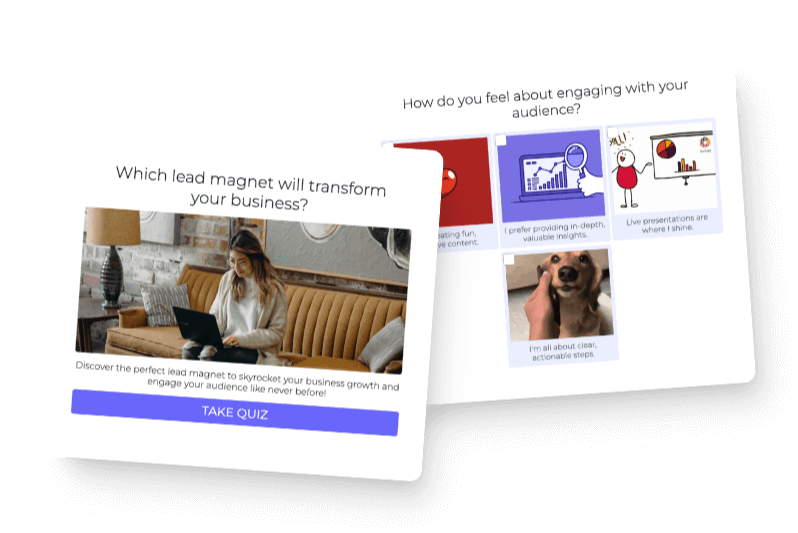

It feels good to be seen. It feels good to be heard. It feels good to be recognized. A quiz, with its unique question and outcome format, can give people all of those “Feel Good” things.
For a quiz, it starts off with the question you are asking people in the title. If you ask people a question that mirror what they are already wondering for themselves, they will feel seen. So if they wonder to themselves “What Career Should I be In?” “Am I Good With Money?” “How Well Do I Actually Understand AI?” and then your quiz title is basically that exact same question, people will immediately feel like you “get” them, even if it’s subconscious.
Moving into the questions, which come next, you can continue making people feel seen, but also make them feel heard. Questions that continue to ask about particular aspects of the main question your quiz is answering can make people feel even more seen. You can ask about parts of the overall issue, and ask in a way that demonstrates you truly understand the world of the person who is taking your quiz. Honestly, asking questions that are applicable is one of the fastest ways to cut through all the noise and make someone feel seen. Think about how hard it is to ask great, specific questions. If you can do that in your quiz, it instantly connects you with the quiz taker, and they feel great.
Questions also introduce the feeling heard part of “Feel Good” marketing. People deeply crave to be asked about themselves. It’s written in our DNA. Evolutionarily, if no one paid attention to us, we would die. So when a person is asked about themselves, it stirs up all sorts of positive emotions. Now to caveat, it’s not just asking about anything. You cannot just ask people generic questions and evoke positive feelings. You have to ask questions that once again mirror what is on the mind of the quiz taker. If you can match your questions to things your quiz taker already mulls over in their own minds, then they will feel very heard because essentially they’ve been ruminating on those thoughts in their head, and knowingly or un-knowingly, they’ve been begging for someone to ask them about it. If your quiz does that, it’s like a release valve, and positive emotions flow out.
In the outcomes of your quiz, you can recognize people, and their reaction to seeing themselves reflected back in their quiz outcome, in a positive framing, is powerful. The technique here is to take what the quiz taker told you in their answers to the quiz questions and reflect it back to them as their quiz outcome, with positive psychology employed to make everything sound like a good thing. Interestingly in our studies, you actually don’t need to be super specific in how you do this. You only need to anchor on one or two unique parts of the quiz taker, and make those the focal point of the quiz outcome. Using words to explain those unique aspects of the quiz taker in a way that makes the quiz taker feel capable, powerful, invigorating. Seeing yourself in a quiz outcome, framed in a way that helps you answer the initial question posed by the quiz, with a way to reach the desired state of yourself, is one of the best feelings ever. It feels like it’s totally possible to get what you want, and not only to get what you want, but to get what you want in a way that works for who you are. People absolutely love that feeling.
Now you might be asking: Okay this is all fine and dandy, but I’ve got a business to run, and I need leads and sales, I can’t just be out here making people feel good! Great question, let’s look at how that works in a quiz.
In a quiz there are two focal points of conversion.
- Right after the questions, before the outcome is shown, a lead opt-in form can appear, asking people if they would like to enter their information so you can continue helping them.
- In the outcomes of the quiz, there are unique call to actions for each outcome that lead people to products, services, or content that would be uniquely helpful to their outcome.
You will notice, the first conversion point, the lead capture, comes pretty late in the quiz. After someone has already answered all the questions. In our data, this means they’ve already been engaging with your quiz for 2-3 minutes. This is because you have now had plenty of questions to make the quiz taker feel good by asking them relevant questions. It’s also because at this point, if you’ve asked great questions, the quiz taker feels responsible to reciprocate and enter their email because you as the quiz creator have put in so much work creating a great quiz, the principle of reciprocity comes in. And finally it’s because of the loss aversion effect. The quiz taker has already put in 2-3 minutes of their time, and does not want to lose that time by leaving now. Now I’ll caveat and say that I recommend leaving the opt-in optional, because conversions don’t go down, and it makes people feel like they have agency, which is super important in all of this. If you want people to buy from you, they need to feel like they want to buy from you, not like they have to. Leaving the opt-in optional serves that purpose by giving them the choice. So if they choose to opt-in it’s of their own choice.
The second conversion point is a call to action in the quiz outcome, is where you connect your products, services, content. Here, you want to think about what feels good for the quiz taker again. Do they want to jump straight to a product to buy? Maybe they do, and if that’s the case, then link straight to a product. Do they want to continue learning and gathering data before making a decision? Then link to further content on the subject. Do they want to dip their toes in the water by buying a low priced product from you to see how you can deliver for them? Then do that. You want it to feel like a continuation of the “Feel Good” precedent you set in the quiz. Not like a bait and switch. So whatever feels good to the quiz taker is how you want to introduce this call to action.
Alright, so quizzes can make people feel seen, heard, and recognized. All three of those are core desires in the brain and have strong psychological ties. If you can effectively connect with those three things throughout your quiz, including the parts that benefit you as the business creating the quiz, then you will see excellent results.