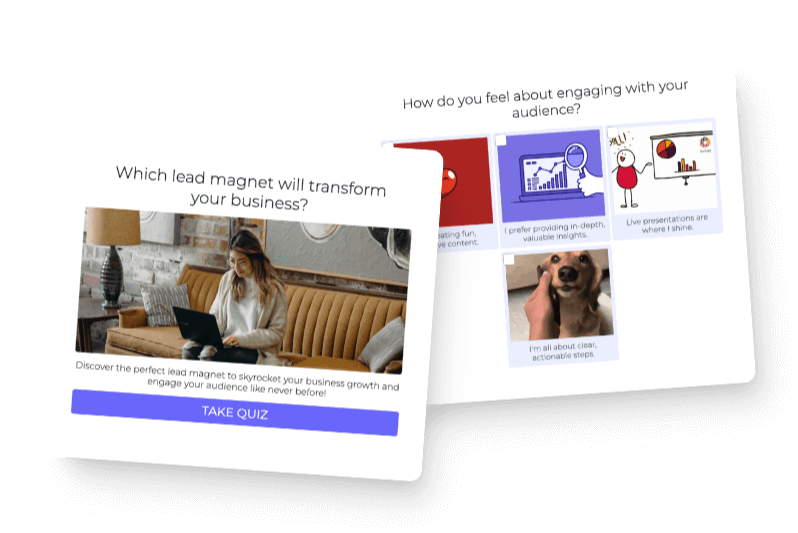

AI has made information abundant. The next competitive advantage is helping each person find the answer that is right for them.
For a long time, the job of marketing was to make information easier to find. That job is changing.
I’ve been thinking a lot about where marketing is going, partly because the language that worked for Interact for a long time has lost some of its pull.
For years, the pitch was straightforward: turn traffic into leads. You have people coming to your website, your Instagram account, your podcast, or your other channels. Put a quiz in front of them, give them a useful result, and turn some of that attention into email subscribers.
That still works. The product still does what it has always done. The harder truth is that the market does not care about that promise in quite the same way it used to.
There are more lead-generation tools. There are more ways to automate a funnel. Webinars are popular again. Downloadable guides are familiar. DM automations are everywhere. AI can produce a landing page, an assessment, a chatbot, a sequence, and twenty pieces of content before lunch. The old category has become crowded, and ‘grow your email list’ now sounds less like a point of view and more like a feature on a very long menu.
So I started asking a more basic question: Why do the best quizzes work in the first place? Not what buttons people click. Not what the opt-in rate is. What is happening for the person taking the quiz?
The answer I keep coming back to is simple: the quiz helps them make a decision they already want to make.
People are not short on information anymore. They are short on clarity.
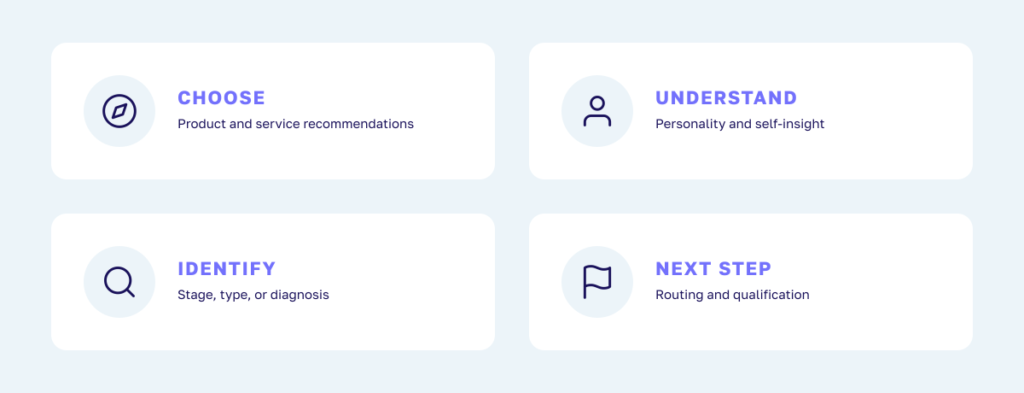
That distinction matters because it moves the conversation away from quizzes as a tactic and toward the larger job that good marketing has always done: helping people choose, helping people understand, helping people identify what is going on, and helping people know what to do next.
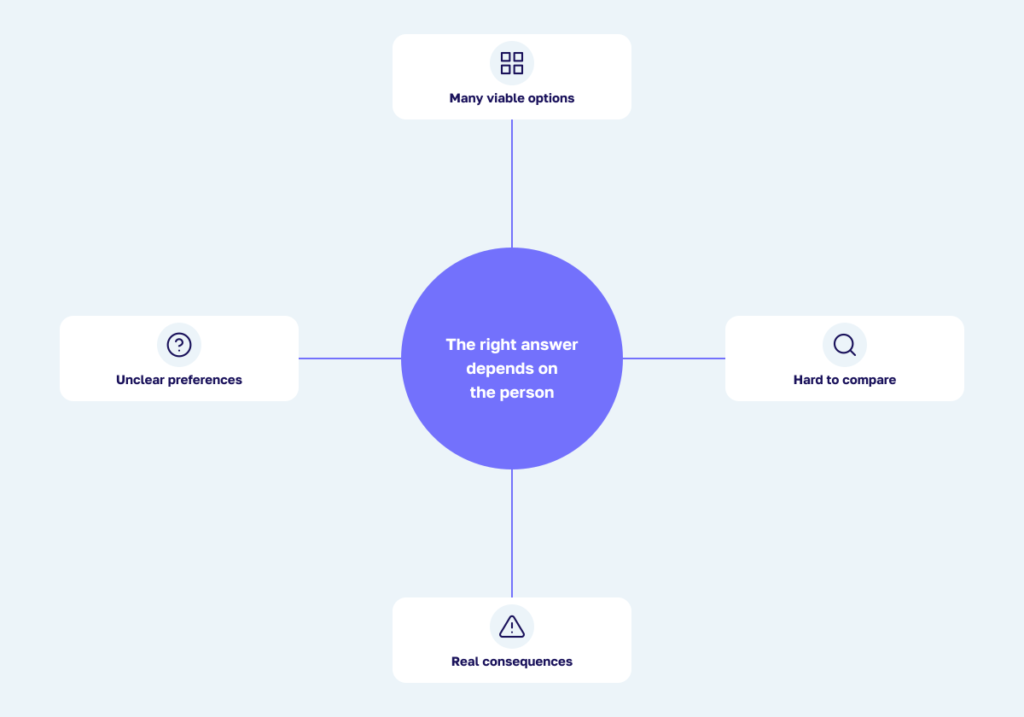
When the right answer depends on the person, generic content can only take you so far. At some point, the customer needs a pathway that accounts for who they are, what they want, what they have already tried, and what constraints they are working with.
That is the opportunity. And I think it is much bigger than quizzes.

Information Used to Be the Advantage
There was a long stretch of internet history when publishing useful information was a genuine competitive advantage. If you knew the answer to a question and put it online, you could attract an audience. If you organized those answers better than everyone else, you could build a brand.
Search engines rewarded comprehensive libraries. Social platforms rewarded educational posts. Businesses learned to package expertise into blogs, videos, podcasts, ebooks, webinars, and courses. The basic assumption was that the customer had an information gap, and the marketer’s job was to fill it.
That model did not disappear overnight, and it is not useless now. But information itself is becoming less scarce. Generative AI can summarize the common advice in almost any category. It can explain concepts, compare options, and create a reasonable first draft of nearly anything. Stanford’s 2025 AI Index reported that organizational use of AI rose sharply, which is another way of saying that cheap, fast content production is no longer a theoretical future. It is the environment we are already operating in.
The obvious response is to produce more. More articles. More clips. More emails. More variations. But when everyone has access to the same production leverage, volume becomes a weak moat.
The stronger question is: What remains difficult after information becomes easy to produce?
Judgment remains difficult. Trust remains difficult. Understanding a specific person remains difficult. Turning a messy situation into a clear next step remains difficult.
In other words, the value moves downstream – from delivering information to helping someone use it.
The value of expertise is not just knowing facts. It is knowing which facts matter for this person, in this situation, right now.
The Real Question Is Usually “What Is Right for Me?”
Most people do not experience their problem as a clean search query. They experience it as a pile of competing considerations.
A parent looking for a family car is not simply asking for a list of SUVs. They are weighing the number of children, car seats, cargo, parking, budget, driving habits, and personal preferences. A person exploring a career change is not asking for a generic list of high-growth jobs. They are trying to reconcile strengths, values, experience, lifestyle, risk tolerance, and identity.
The facts are available. The fit is not.
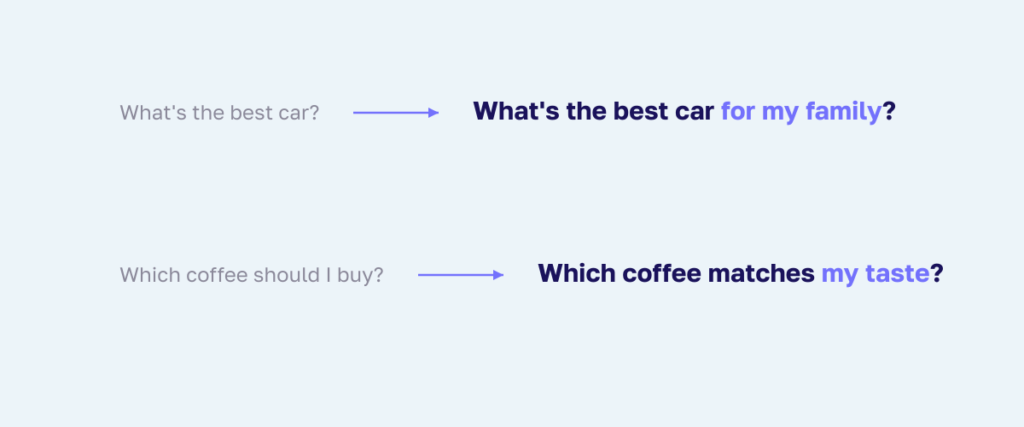
That is why so many of the strongest Interact customer stories begin with a question that contains an invisible phrase: ‘for me.’
- Which car is right for my family?
- Which career path fits me?
- Which coffee matches my taste?
- What is my attachment style, and what does it mean for my relationships?
- Which service should I book?
- What should I focus on next in my business?
- Which bird did I just see?
- What kind of support do I need right now?
These questions are attractive because the person already wants the answer. The quiz does not manufacture interest out of thin air. It captures a moment of intent and gives that intent somewhere useful to go.
This is also why speculative quizzes are harder to sell. A business without an audience, without meaningful traffic, and without a recurring customer question does not have much pent-up demand to capture. A quiz is not a substitute for attention. It is a way to make more of the attention a business has already earned.
A Quiz Is a Personalized Decision Engine
For years, we have described quizzes as lead magnets. That language is understandable, but I now think it puts the least interesting part first.
A downloadable guide is a lead magnet. A webinar can be a lead magnet. A discount code can be a lead magnet. The phrase describes what the business receives, not what the customer experiences.
A well-designed quiz is different because it asks the customer to participate in creating the answer. It gathers context, interprets that context through the business’s expertise, and returns a recommendation, identity, diagnosis, or next step.
That makes it less like a static piece of content and more like a small decision system.
The business contributes a framework. The audience member contributes information about themselves. The result is more relevant than either side could create alone at scale.
Seen this way, the email address is not the primary value exchange. Clarity is the value exchange. The opt-in happens because the person has already experienced the business as useful and wants to continue.
This is consistent with how Interact quizzes are structured: the opt-in appears after the questions, when the participant has already invested attention and expects a result. The best funnels are not forcing someone to trade an email address for a vague promise. They are demonstrating usefulness first.
The lead is the byproduct. The real product is a clearer decision.
The Customer Stories Make the Pattern Obvious
The strongest evidence for this idea is not a marketing theory. It is the range of businesses already using quizzes to perform the same underlying job.
1. Help Me Choose
The Car Mom is one of the cleanest examples. Kelly Stumpe built a large audience by helping families navigate the car-buying process. People trust her, and naturally they want her recommendation for their specific situation.
The problem is that personalized recommendations do not scale through direct messages. Each family has different needs. The quiz turns Kelly’s expertise into a branching pathway that narrows hundreds of vehicles into a smaller set of relevant options. Interact’s 2026 case study describes it as The Car Mom’s top email-list growth tool, but that outcome makes sense only because the quiz first performs a valuable job: it helps a family choose.
Henry’s House of Coffee solves a smaller but structurally similar problem. The Kalebjian family has generations of coffee-roasting knowledge. In a physical coffee shop, a knowledgeable person could ask about taste preferences and recommend the right beans. Online, the quiz recreates that conversation. The customer does not need another page describing every roast. They need help translating their preferences into a choice.
The same model works for skincare, supplements, services, courses, software plans, financial education, and nearly any category with several reasonable options. The more the answer depends on preferences or context, the more valuable the guidance becomes.
2. Help Me Understand Myself
Other quizzes create value through self-understanding rather than product selection.
Dr. Morgan’s attachment-style quiz has generated tens of thousands of subscribers over several years. Its durability is revealing. Attachment theory is not a novelty topic invented for a campaign. People repeatedly want to understand how their patterns affect their relationships. The quiz offers an approachable entry point into a deeper body of work.
Carly Banks of The Habit Ayurveda has used a dosha quiz to help people understand themselves through an Ayurvedic framework. Interact reported that the quiz generated more than 170,000 leads. Again, the number is impressive, but the underlying reason matters more: people are deeply curious about themselves when the result promises a useful lens rather than a shallow label.
Alyssa Zander turned material about codependency and the mother wound into an interactive quiz. The podcast conversation highlights why the format worked: it created a lighter, more approachable entry into emotionally heavy personal-development work. The quiz did not trivialize the topic. It gave people a manageable first step.
Caitlin Mahina Green’s archetype quizzes work in a similar way. The result helps people feel seen, then guides them toward relevant content and offers. This is segmentation, but it does not feel like segmentation from the participant’s side. It feels like recognition.
3. Help Me Identify
Scott Keller’s birdwatching quiz is a useful reminder that personalization does not always need to be psychological. Sometimes the job is identification.
A person sees a bird and wants to know what it was. The quiz asks about observable characteristics and narrows the possibilities. According to the Interact podcast, that quiz grew to hundreds of thousands of email subscribers.
The same structure can identify a style, a stage, a risk, a bottleneck, a readiness level, or a likely category. The question is compelling because uncertainty already exists. The quiz reduces it.
4. Help Me Find My Next Step
Many coaching and service businesses are not selling a single product. They are helping people move through a sequence.
Holly Marie Haynes uses quizzes to personalize the customer journey in a crowded market where buyers may take longer to convert. Questions about a person’s stage help determine which content, product, or offer makes sense. The quiz also creates audience intelligence for the business, because Holly can see how people describe their current situation.
Hannah from Life Is Worth Loving uses relationship quizzes to help people identify where growth is needed and route them to relevant resources. Coconut uses branching assessments in hiring to screen applicants and match virtual assistants with business needs, saving human time while preserving the logic of a thoughtful evaluation.
These examples look very different on the surface. One is a creator business. One is relationship education. One is hiring infrastructure. Underneath, they all ask the same question: based on what we now know about you, what should happen next?
Why This Is a Hedge Against AI – and Why “AI Cannot Personalize” Is the Wrong Argument
It would be easy to make a lazy argument here: AI gives generic answers, while quizzes give personalized ones. That is not quite true. AI can personalize. It can ask follow-up questions, remember context, compare options, and generate tailored recommendations.
The more honest argument is that AI changes what customers expect and what businesses must own.
When anyone can open a chatbot and ask for advice, a business cannot defend itself by having information alone. It needs a trusted framework, a distinct point of view, and a pathway that connects the recommendation to something the business can actually deliver.
A strong quiz does three things that matter in that environment.
- It encodes the business’s judgment. The outcomes reflect how a specific expert categorizes the problem, not an average of everything published online.
- It creates a consistent experience. Every participant moves through a deliberately designed set of questions and receives guidance aligned with the brand’s methodology.
- It connects insight to action. The result can lead directly to the right resource, product, service, or conversation instead of ending with a floating answer.
AI can strengthen every part of this. It can help draft questions, analyze response patterns, create result variations, and support follow-up. But the strategic asset is not the generated copy. It is the decision architecture.
This also points to an ethical advantage. Recommendation systems can lose trust when they are opaque, invasive, or manipulative. A quiz can be transparent about what it asks and why. The participant knowingly supplies the inputs. The business can explain the result. The person retains control over the next step.
AI can generate an answer. Your advantage is designing the trusted path from a person’s situation to a useful action.
That combination – personalization with visible participation – is worth preserving as AI becomes more ambient.
Choice Overload Is Real, but Context Matters
The idea that too many choices can paralyze people is popular because it feels true. The research is more nuanced than the slogan.
Meta-analyses have found that choice overload does not happen in every situation. Its effects depend on factors such as the complexity of the choice, the difficulty of comparing options, the person’s expertise, and how clearly their preferences are defined. That nuance actually strengthens the case for personalized guidance.
The opportunity is not to assume that every large assortment is bad. It is to recognize the conditions under which a customer needs help: the decision is consequential, the options are hard to compare, the customer is uncertain about their preferences, or there is no obvious dominant choice.
That is exactly where a recommendation experience earns its keep. It reduces the dimensions the customer must hold in their head. It asks questions in sequence. It makes the reasoning legible. It turns a complex menu into a smaller and more meaningful set of possibilities.
The goal is not to remove choice. The goal is to make choice usable.
The Business Gets More Than a Lead
When we talk only about email-list growth, we undersell what the business learns.
A quiz can reveal what stage people are in, which problems are most common, what language they use, what outcomes they want, which offers fit, and where the audience is coming from. Interact has seen this internally: response data showed that Instagram had overtaken websites as a leading source of attention for many users, reflecting a real shift in how audiences are built.
Holly Marie Haynes uses questions about business stage to understand her audience and position products more appropriately. Advice With Erin gathers demographic and career information that can inform future content. Product-recommendation quizzes reveal preferences before the sale rather than forcing the business to infer everything from purchase history.
This is first-party data with context. The audience is not being silently tracked across the internet. People are answering because the questions are part of receiving value.
Used responsibly, that creates a useful loop:
- The audience receives a better recommendation.
- The business understands the audience more clearly.
- Content and offers become more relevant.
- Future recommendations improve.
The quiz is therefore doing at least four jobs at once: engagement, decision support, segmentation, and research.
This Is Not for Everyone – and That Is Useful
One of the clearest strategic lessons is that a quiz works best when a business already has attention and a recurring question worth answering.
That means the honest market is narrower than ‘anyone who wants leads.’ The strongest fit is a creator, educator, coach, service business, ecommerce company, or established brand with three things:
- An audience or steady stream of visitors.
- A problem whose best answer varies by person.
- A meaningful next step after the result.
Without attention, there is nothing to convert. Without a personalized problem, a static page may work better. Without a next step, the result becomes entertainment without business value.
This qualification is not a weakness. It is a clearer position.
Interact is not a magical audience-building machine for people starting from zero. It is infrastructure for businesses that have already earned attention and want to make that attention more useful.
Put more directly: do not waste what you have already earned.
A quiz does not create pent-up demand. It unlocks the demand already sitting inside an audience.
A Better Way to Talk About Quizzes
This leads to a different content strategy for Interact.
Instead of starting with the solution – ‘you should build a quiz’ – start by establishing the shared problem.
You have an audience. People are paying attention. Some of them are trying to make a decision. Most of your content still gives everyone the same next step. That means potential value is being left on the table.
From there, Interact can enter existing demand through familiar business questions:
- How do I increase website conversion?
- How do I turn Instagram followers into customers?
- How do I recommend the right product?
- How do I personalize the customer journey?
- How do I qualify leads without adding more calls?
- How do I segment my audience based on what they actually need?
- How do I collect useful first-party data?
- How do I make interactive content that is actually useful?
Those are the doors. The larger point of view is what connects them: when the right answer depends on the person, create an experience that learns enough to guide them.
The quiz can stay in the background until the mechanism becomes relevant. This avoids asking people to believe that quizzes are inherently important. It demonstrates why a personalized pathway is important, then shows why quizzes are a practical way to build one.
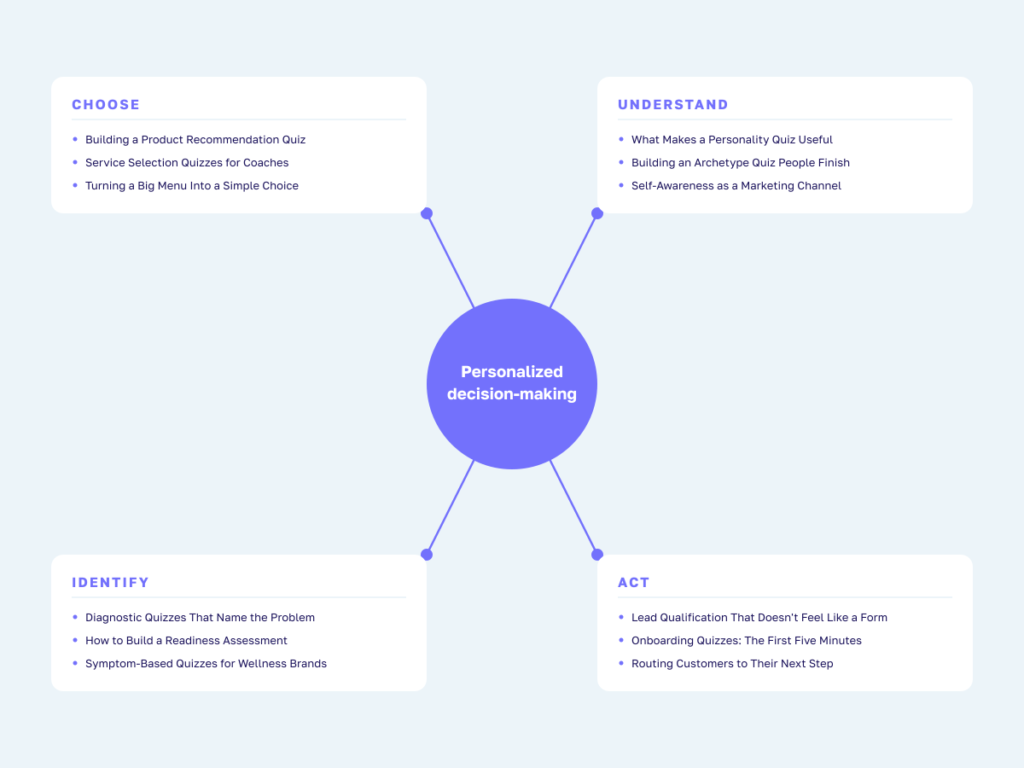
The Four Content Lanes
A useful editorial system could be organized around four customer jobs.
Help me choose: Product recommendations, service selection, plan selection, offer matching, comparisons, and decision trees.
Help me understand: Personality, archetypes, relationship patterns, strengths, preferences, and self-awareness.
Help me identify: Stages, types, bottlenecks, risks, readiness, symptoms, and categories.
Help me act: Next-step assessments, lead qualification, learning pathways, onboarding, and routing.
Each lane can include educational articles, customer stories, templates, podcast clips, and practical guides. Together they build a category larger than quiz software without drifting away from what Interact actually enables.
What Good Personalized Guidance Looks Like
Not every quiz deserves to exist. A weak quiz simply adds friction. A strong one earns attention by respecting the participant.
The best experiences share a few characteristics.
They begin with a real question
The topic comes from something the audience already asks, searches for, comments about, or sends in direct messages. The business is capturing demand, not inventing an abstract personality test because quizzes are supposedly engaging.
They ask only what changes the recommendation
Every question should help distinguish between outcomes or improve the usefulness of the result. Curiosity about the audience is not enough reason to collect data.
They make the framework understandable
People trust recommendations more when they can see how the conclusion relates to their answers. The result should not feel like a slot machine.
They provide a meaningful result before the pitch
The result needs substance. It should explain the category, reflect the person’s situation, and offer an initial action. A thin result followed by an aggressive sales page breaks the value exchange.
They route, rather than merely label
A label may create recognition, but the business value comes from the pathway after it. What should this person read, buy, book, try, or consider next?
They preserve agency
Personalization should help someone make a decision, not disguise manipulation. Be clear about data collection, make email optional when appropriate, and avoid pretending that a short quiz can provide a clinical diagnosis or certainty it cannot support.
In the Interact podcast, Josh has described a great quiz as a great conversation. That is the right standard. It should feel like the questions an expert would ask if the person were sitting across from them, followed by the answer that expert would genuinely give.
The Strategic Opportunity for Interact
The quiz category is crowded. The broader decision-support category is also crowded. AI will make both more competitive.
Interact’s advantage is not that no one else can ask questions or generate outcomes. It is thirteen years of pattern recognition about what makes these experiences work across creators, coaches, ecommerce businesses, educators, and larger organizations.
There is a real body of evidence here: more than 100 million leads generated through quizzes, long-running customer funnels, and hundreds of conversations about why people participate and what businesses learn.
The opportunity is to turn that evidence into a clear point of view:
When the right answer depends on the person, the best marketing helps them find it.
That statement is broad enough to matter and specific enough to guide product, content, sales, and customer education. It explains why quizzes are valuable without requiring quizzes to be the headline. It gives Interact a credible position in the AI conversation without claiming AI is incapable. It connects list growth, personalization, segmentation, product recommendations, and audience intelligence under one idea.
Most importantly, it starts from what the customer is trying to accomplish, not what Interact is trying to sell.
The Future Is Less Content, More Guidance
I do not think content is going away. I think its job is changing.
Generic educational content will remain useful, especially when a person is learning the basics. But as information becomes easier to create and retrieve, businesses will need to do more than explain. They will need to help people apply.
That might look like a product finder, a diagnostic, an assessment, a decision tree, a calculator, an onboarding pathway, a guided conversation, or a quiz. The format matters less than the function.
The function is to take the complexity of the business’s expertise and turn it into a clear next step for a specific person.
That is not a growth hack. It is what a good salesperson, advisor, teacher, or shopkeeper has always done. The internet first helped us publish that expertise. AI now helps us produce and retrieve it. The next step is to make it responsive.
The businesses that win will not be the ones that simply have the most answers. They will be the ones that ask the right questions, understand the person in front of them, and guide them toward a decision they feel confident making.
That is the future of marketing I believe in.
And quizzes are one of the most practical ways to start building it today.