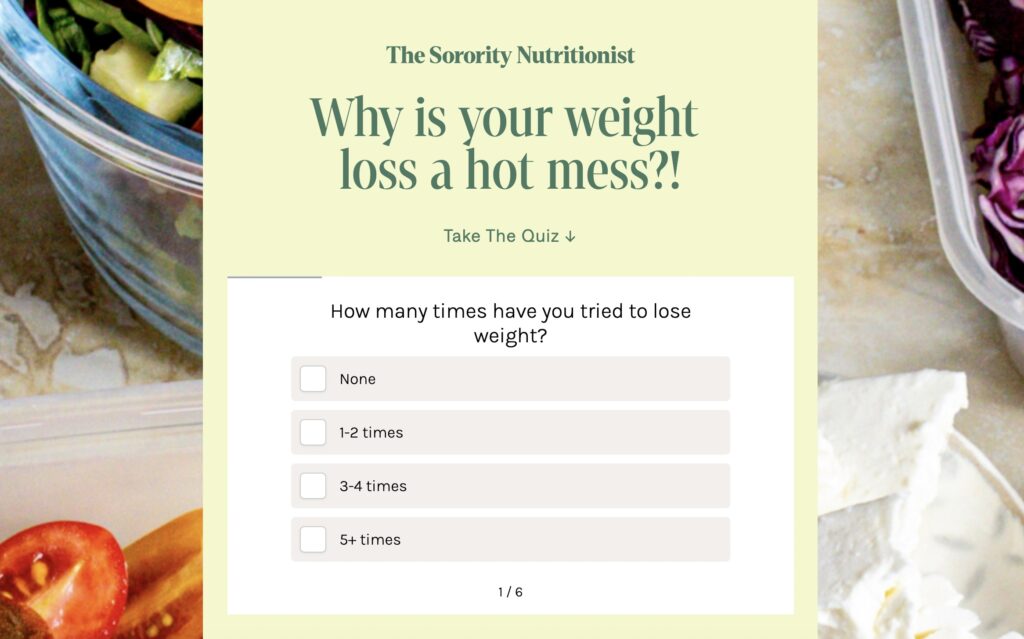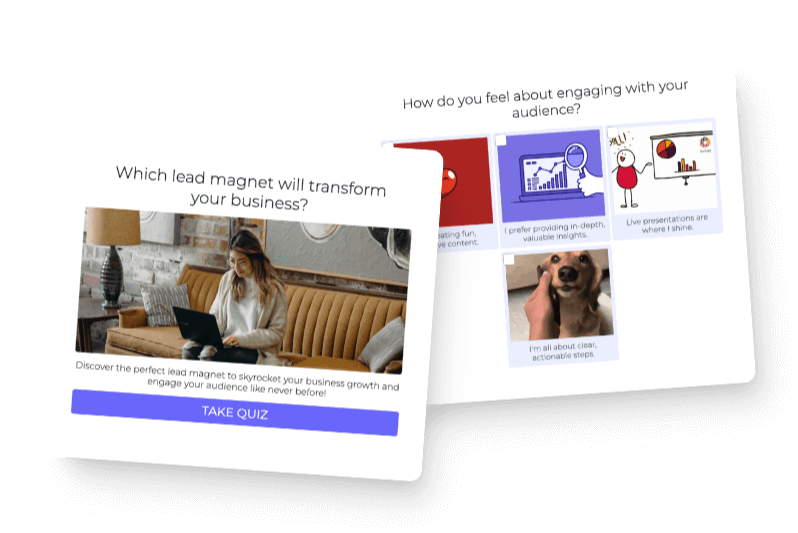
The most effective types of lead generation quizzes help your customers connect the dots between what they want and what your business can offer. They build a bridge between what is in the mind of your potential customer and your products or services. Here are the four main quiz types for driving lead generation.
- Personality or Archetype Quiz. Helps the quiz taker identify their personality type or archetype so they can use it to get something they want or remove something they do not want.
- Diagnostic Quiz. Helps the quiz taker identify what is wrong so they can fix it.
- Assessment or Scored Quiz. Helps the quiz taker find their current status so they can improve their status.
- Product Match Quiz. Helps the quiz taker find the right product or set of products for their needs and preferences.
Detailed Description of Each Quiz Type
1. Personality or Archetype Quiz
This type of quiz identifies the quiz takers’ personality type or archetype so they can use it to get something they want or remove something they don’t want from their lives.
How Personality Quizzes Work Logistically
Logistically, this quiz type has different outcomes that are the personality types or archetypes. The outcome a quiz taker receives is based on which one they get the most points for. Each question has different answer choices, and each answer choice can give a point to one or more of the outcomes. Whichever outcome has the most points for the quiz taker once they answer all the questions is the one shown to them.
People often refer to this as “Mostly A’s” “Mostly B’s” “Mostly C’s” as in whichever outcome you choose the most of is the one you see as your result. This is classically how personality quiz scoring works.

Why Personality Quizzes are Effective for Lead Generation
Personality quizzes and archetype quizzes are effective because people want an answer to the question “What will work best for ME?” or “How can I get rid of something I don’t want?” and in order to answer those questions, you need to know what type of person they are. The specific reason why personality quizzes and archetype quizzes are so effective at answering this question is because they can answer the question for the quiz taker on an individual level while also not making them feel alone. Because the answer to what they want is being given in the form of a personality type or archetype, there is reassurance that they are not the only ones who are the type that they are. Which propels the quiz taker towards action instead of overwhelm. When people feel alone, they get overwhelmed and shut down. When they feel seen, but also in good company, they are more likely to take action, which is why personality quizzes are so effective for lead generation because they make people feel seen but also included, and then they are ready to take the next step, which is to become a lead for your business.
This quote sums up the reason why knowing your personality type is so important.
“The game of investing is a process of discovering who you are, what you’re interested in, what you’re good at, what you love to do, then magnifying that until you have a sizable advantage over all other people.” – Li Liu
He’s speaking on investing specifically, but the same is true for any endeavor in life, and that’s why people are so drawn to discovering their personality type.
Example of a Successful Personality or Archetype Quiz
This example is from Jamie Sea and it helps people find their visibility archetype. It connects people with their type, so they can use their type to their advantage and increase their visibility.

Here is what the questions look like, you answer questions about how you currently show up so the quiz can create the correlations needed to recommend your visibility archetype at the end.

After the questions the opt-in form appears to see your archetype. This is the best place to ask for the lead because people can see and feel from the way you ask questions that you know what you are talking about. Asking the right questions requires you to know a lot about the person you are asking questions to. So if people resonate with the questions you ask, they know that you understand them. This is the reason why the average conversion rate on this opt-in form is 40% over 100 million leads generated since 2013.

After the opt-in form, as the quiz taker you see your quiz result right away, on the same screen. In this case, it redirects to a landing page on the Jamie Sea website, but you can also show the results within the same embedded quiz through Interact.
These results tell you your archetype, and how you can use it to your advantage to gain more visibility.

2. Diagnostic Quiz
A diagnostic quiz is functionally the same as a personality quiz, but instead of identifying a personality type or archetype, you are identifying a problem. You are diagnosing an issue for the quiz taker, from a list of distinct issues that the quiz taker could be facing in a particular area.
Why Diagnostic Quizzes are Effective for Lead Generation
If your audience knows they have a problem but don’t know why they have that problem, they will trade you their email address and permission to email them if you can solve their problem. The very basic trade happening in a diagnostic quiz is that you give them an answer to what is causing their issue, and they give you their email address. It’s straightforward but highly effective.
Example of a Diagnostic Lead Generation Quiz
A great example of a diagnostic lead generation quiz is from The Mind Friend, created by Charlotte Grimmel. The quiz asks the question “What’s Your HIDDEN Success Blocker?” for an audience who knows something is holding them back, but is just not sure what the problem is.

You answer questions in this quiz, and on the backend it’s functioning the same as a personality quiz. Each answer choice is correlating (giving a point to) one or more of the hidden success blockers, and whichever hidden success blocker has the most correlations when you complete the questions is the one shown to you as your result. Side note, but I’ve been seeing a trend towards this type of diagnostic quiz where the results are scoring people in a bunch of different areas, which does not psychologically make sense. From a human standpoint, people prefer if you only give them one thing to work on at a time. Giving a whole report of things to work on typically just leads to overwhelm, and people not doing anything, including not working with you.

At the end of this quiz, once the quiz taker has answered all of the questions, an opt-in form shows up. It shows before the results are revealed, and the offer is to trade your email to see your hidden success blocker. This is a good offer, and if the questions themselves have built trust with the quiz taker because the questions were relevant and resonated with the quiz taker, then they will likely enter their email address to see their result, because they trust that whatever the quiz creator will send via email will be helpful just like the questions themselves were helpful.
This is the super fascinating part of quizzes, which is the subtle psychological element of asking great questions. Asking great questions is the fastest way to build trust with people. Asking the right questions immediately signals to people that they can trust you, because you know what is going on in their world.

After the opt-in form, you see your result right away, you don’t have to wait to receive an email. Although the results will also be sent by email, which I will show you next. Everything in this result is written in second person “You” language. Years ago we did a study and found that the higher concentration of the word “You” leads to better engagement for people readying quiz results. It feels more personal, more tailored, when you write it that way.

Immediately you’ll also get an email in your inbox from The Mind Friend, Charlotte Grimmel, with an email-modified version of your results. By email modified, I mean simplified and abbreviated so that if you want to pull up that email later it’s easy to read and skim through.

If your audience is asking themselves “What’s wrong?” then a diagnostic quiz can speak directly to their pain and draw them in. When people know there is something wrong, they want an answer for what is wrong. A well crafted diagnostic quiz can do exactly that.
Assessment
An assessment quiz answers the question “What’s my status?” which is a question people ask themselves all day long. Comparison with others is hardwired into psychology, and everyone does it. So an assessment taps into that desire to compare and helps people find out where they stand. Of course, the goal is always to help people improve, but from a human standpoint, people are taking assessments because they want to compare themselves to others.
Why Assessments Generate Leads
If the questions you ask in your assessment make people re-feel the pain they feel in not having the status they desire, then when you ask them to join your email list at the end of the questions, they are ready to go. Your goal is to help them, and they want to know that you understand their situation before they would trust you to help them. If you can address the pain directly in the way you ask the questions, that builds instant trust with people and they are ready to opt in at the end of the quiz.
Product Match
Product match quizzes connect people to a product or service that will make their life better. Better can mean more enjoyable, more comfortable, more glamorous, more fun, and so on. People are looking to buy something that makes them feel good. And a product match quiz can help fulfill that desire.
Why Product Match Quizzes Generate Leads
Product match quizzes offer a discount on the recommended product or set of products if the person taking the quiz chooses to opt in for email updates. This works because if someone already spent the time to answer the questions of your quiz to get their product match recommendations, then they would be interested in buying the recommended products at a discount.