
Kelly Smith has spent nearly nine years building the Mindful in Minutes podcast. When I interviewed her, she described a library of more than 700 episodes covering sleep, anxiety, morning routines, short practices, spiritual exploration, and many other moments when someone might need meditation.
That depth of content is an incredible asset. It also creates a very practical problem for a new listener: where do you start?
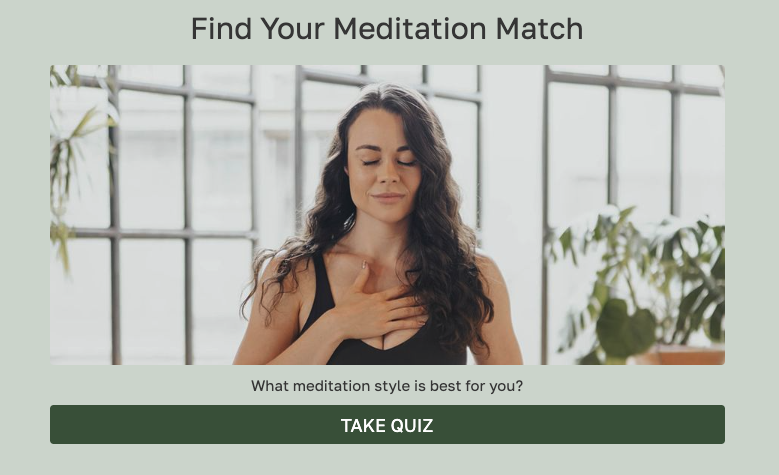
Kelly’s Find Your Meditation Match quiz answers that question in about two minutes. It asks eight questions about the person’s life, goals, stress patterns, and relationship with meditation, then routes them to a meditation archetype and a personalized playlist drawn from the podcast archive.
This is not a story about using a quiz to manufacture attention from nothing. Kelly already built the attention through years of consistent podcasting. The quiz becomes valuable because it helps turn that attention into a more direct email relationship while making all of the content she has already created easier to use.
The Podcast Came First
Kelly started Mindful in Minutes in 2017 after moving away from the in-person yoga community she had built. She wanted a way to stay connected with her students, and guided meditations had already become a recognizable part of the way she taught yoga.
At the time, one of the hardest parts of podcasting was explaining what a podcast was and how to listen to one. Kelly kept publishing anyway. Her original goal was to have 1,000 people listen, and the audience grew because she kept showing up with useful practices week after week.
Then COVID hit. Before lockdown, Kelly said the show was receiving roughly 5,000 to 8,000 listens in a typical week. During the first week of lockdown in March 2020, she opened the spreadsheet where she tracked the podcast and saw roughly a quarter of a million people had listened.
That spike changed the scale of the show, but it did not mean every week stayed at that level forever. Kelly was candid that podcasting has had ebbs and flows since then, and that some years were stronger than others. The durable advantage was not one moment of explosive growth. It was the library she kept building before, during, and after that moment.
As Kelly put it, you have to ride the wave. The consistency is what left her with an archive substantial enough to become a business asset of its own.
A Large Content Library Creates a Beautiful Problem
By the time we spoke, the archive had become so large that the size itself was getting in the way of discovery. Kelly called it a beautiful problem. The meditations are evergreen, but a listener is not going to scroll through hundreds of episodes to find every sleep meditation or decide which anxiety practice fits what they are feeling today.
The podcast platforms only solve part of this. Spotify and YouTube can support playlists, but Apple Podcasts does not offer the same simple way to organize a large back catalog into curated paths for different listeners. Even where playlists are possible, a new listener still has to know which playlist to choose.
The problem is no longer, ‘Do I have something that can help this person?’ Kelly almost certainly does. The problem is, ‘How do I help this person find the right thing without asking them to search through everything?’ The quiz sits directly in that gap.
The Podcast Playlist Quiz Framework
Kelly worked with podcast growth expert Kylee Chandler to build the strategy. Kylee’s framework is to organize an existing podcast archive into bundles or playlists based on the listener’s goal, challenge, or stage, then use a quiz to route each person to the collection that is most relevant to them.
The value is the curation. The podcast episodes may already be free, but the listener does not have to research, compare, and assemble the right sequence on their own. Someone with a large archive is taking responsibility for saying, ‘Based on what you told me, start here.’
For Kelly, the playlists map to eight current quiz outcomes: the 5-Minute Meditator, the Soothing Sleeper, the Mindful Morning Meditator, the Spiritual Seeker, the Daily Breather, the Anxious Achiever, In My Healing Era, and the Calm Seeker. Each result represents a different reason someone might come to meditation and a different kind of practice that could support them.
This is what makes a podcast playlist quiz different from a generic content recommendation widget. The playlists are not organized only by topic. They are organized around the person and what that person is trying to achieve.
The Questions Ask About the Person’s Actual Life
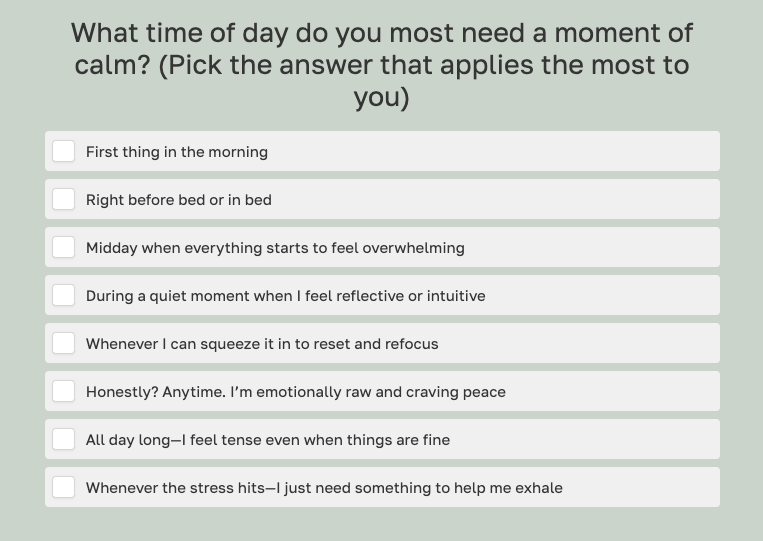
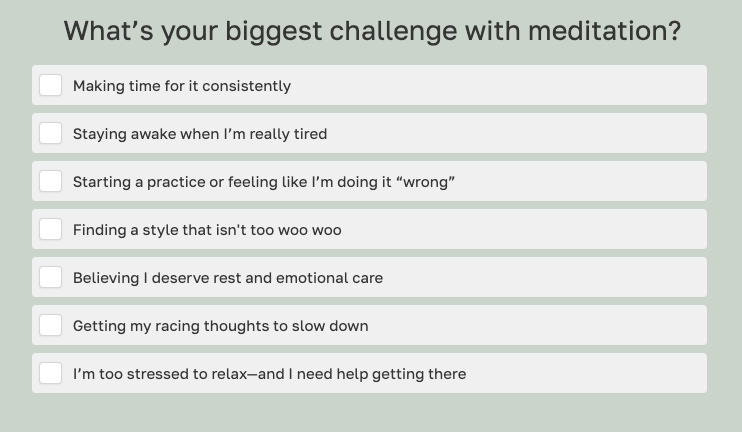
The quiz asks eight questions, and each one adds a different piece of information to the recommendation. It asks what time of day the person needs calm, how meditation currently fits into their life, how long their ideal practice is, which word describes their current season, what motivates them to meditate, how they respond to stress, and what has made meditation difficult.
The wording is specific enough that people can recognize themselves. Someone can say they push through until they crash, that they are emotionally raw and craving peace, that they want something calming they can simply press play on, or that their biggest challenge is finding a style that is not too ‘woo woo.’ Those are not generic personality quiz answers. They sound like real reasons people do or do not meditate.
That specificity matters because Kelly is not simply trying to give someone an entertaining label. She is trying to determine whether that person needs a five-minute reset, a morning ritual, a sleep practice, nervous system support, breathwork, spiritual exploration, or something gentler for a season of healing.
Every useful question serves two purposes. It improves the recommendation the person receives, and it helps Kelly understand the people joining her email list.
The Quiz Encodes Kelly’s Judgment
Kelly’s core belief is that there is no one-size-fits-all approach to meditation. People often picture meditation as sitting cross-legged, closing their eyes, and chanting for half an hour. It can look like that, but it can also look completely different depending on the person, the moment, and what they need.
As someone who meditates, this was the part of the quiz that stood out to me. When I first learned to meditate, a business coach recommended a particular practice after having many conversations with me. The recommendation worked because it came from someone who understood how I was wired and what I was trying to change.
Kelly cannot have a long personal conversation with every listener before recommending a meditation. The quiz lets her encode the patterns she has learned through years of teaching and creating content. A person walks into what is essentially an online meditation store, answers a few thoughtful questions, and Kelly hands them a small set of practices that make sense for them.
A search bar can surface content. Kelly can recommend it.
That distinction becomes even more valuable now that people can search YouTube, Spotify, Apple Podcasts, or an AI tool and receive an endless number of options. Kelly described the familiar experience of searching for an anxiety meditation, scrolling through results for an hour, and never actually meditating. Her quiz reduces the decision-making so the person can move from looking to doing.
The Hard Part Is the Curation
Kelly was very honest about the work required to build the experience. She said there were many points when she wanted to give up on the project. Interact was the easiest part. The hard part was defining each archetype, thinking through the journey for each person, building the playlists, creating the follow-up sequences, and getting the different systems to talk to one another.
That is worth saying because a quiz like this can look simple from the outside. Eight questions go in, one playlist comes out. Behind that simplicity is a substantial amount of expert judgment about which patterns matter and which episodes belong together.
It is also why established creators are particularly well suited to this format. They have heard the same questions for years. They know the different kinds of people who come to them, what each person is trying to achieve, and where each person tends to get stuck. The quiz requires them to make that knowledge explicit.
The experience can run automatically after it is built, but the thought behind it is not automatic. Kelly’s humanity is the part that makes the automation useful.
The Results Give Immediate Value
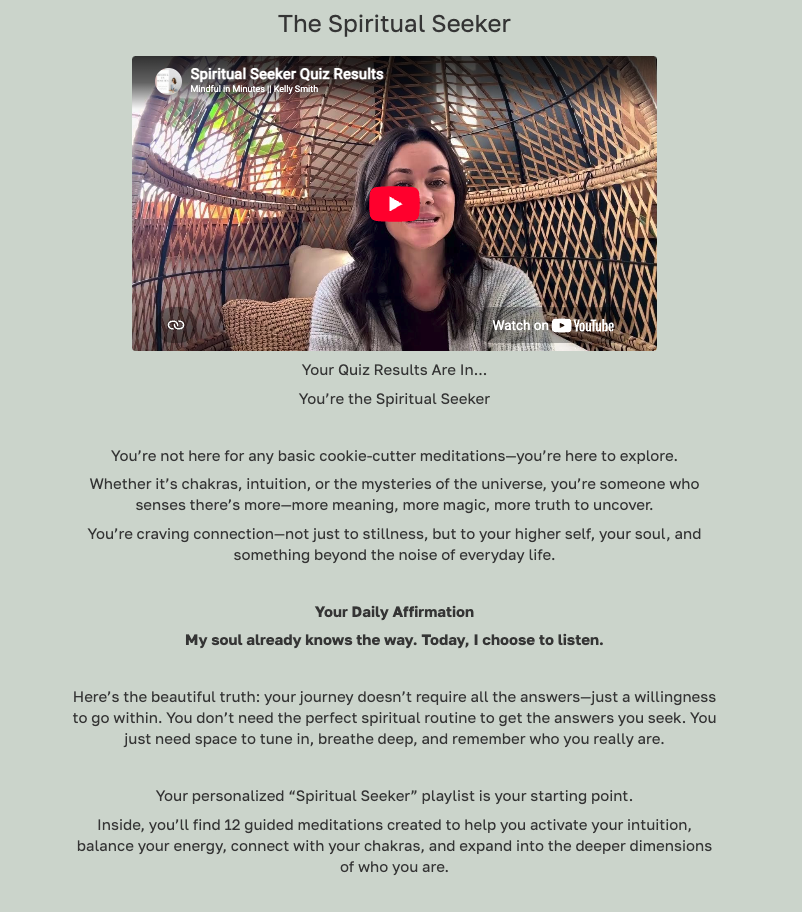
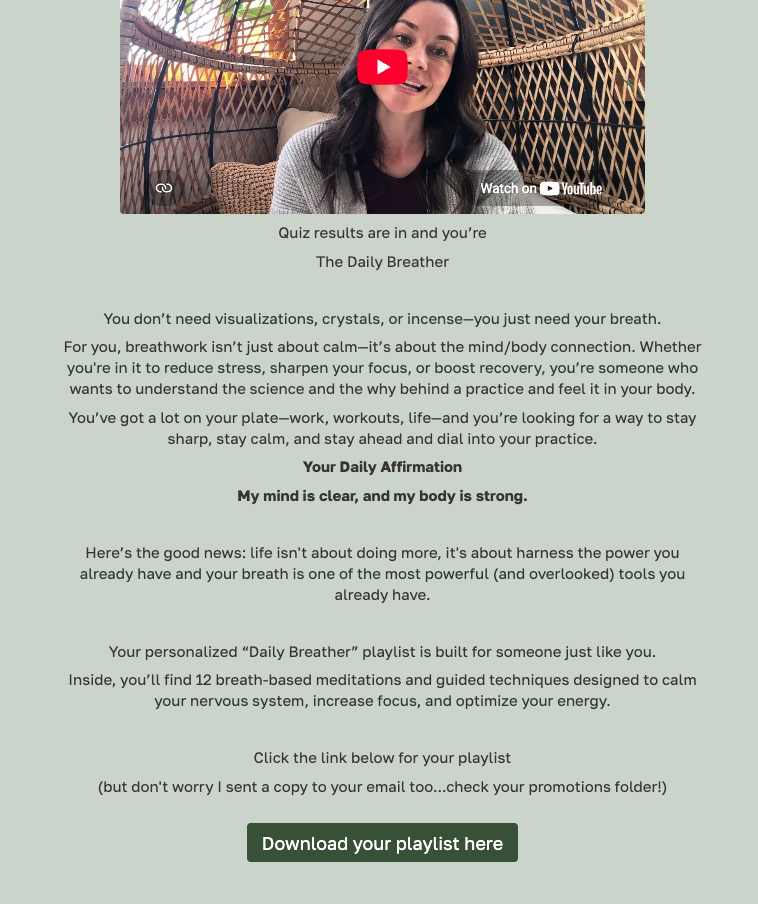
The result pages do much more than display the name of a meditation archetype. They describe what the person may be carrying, why their current approach has been difficult, and what kind of practice is likely to feel manageable. Each result also includes a daily affirmation and a direct path to a personalized playlist.
The 5-Minute Meditator receives a collection of quick practices that can fit into a full day. The Soothing Sleeper receives sleep-focused meditations designed to quiet mental chatter and create a softer end to the day. The Mindful Morning Meditator receives practices for clarity and intention, while the Anxious Achiever receives meditations focused on calming the body, regulating the nervous system, and reducing inner noise.
The current playlists contain 12 selected meditations for each type. Kelly also told me she was already planning additional rounds because the archive contains far more relevant episodes than can fit into one starter collection. The initial result is not meant to expose the entire library. It is meant to give the person a useful place to begin.
Kelly also uses the result experience to deepen the connection through her own explanation and a clear call to continue into the playlist. The person receives self-understanding, practical guidance, and something they can use immediately.
The Opt-In Is Part of the Experience
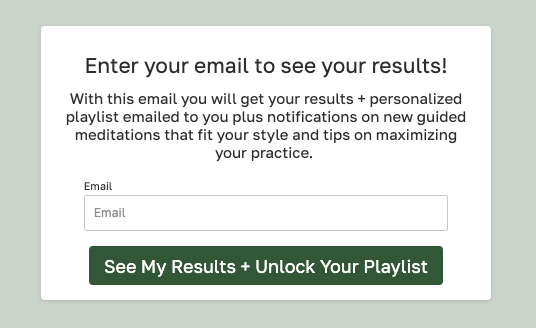
The quiz landing page makes the exchange clear before someone starts. In about two minutes, the person will receive a personalized guided meditation playlist, guidance for making meditation fit their life, a custom meditation archetype, daily affirmations, and notifications when new episodes match their style.
By the time the email opt-in appears, the quiz has already demonstrated why Kelly’s recommendation could be useful. The form is not an unrelated interruption. Email is how the playlist can be delivered, saved, and revisited after the person closes the quiz.
The result pages reinforce that continuity by telling the person that a copy of the playlist has also been sent to their inbox. From there, Kelly can send additional playlists, surface older episodes that still fit the person’s needs, and notify them when a new meditation matches their style.
The email address is not the price of admission to a piece of content that has nothing to do with the quiz. It is the delivery mechanism for the personalized path the quiz just created.
The Quiz Adds Email Without Replacing the Podcast
Kelly features the quiz on the Yoga For You website, in her social link in bio, and throughout the podcast ecosystem. That gives website visitors, Instagram followers, and podcast listeners the same personalized front door into her body of work.
The quiz does not replace the podcast audience she has spent years building. Email is an additive channel. It gives Kelly a direct way to continue the relationship with a listener instead of relying entirely on Spotify, Apple Podcasts, YouTube, or a social platform to bring that person back.
It also changes the quality of the relationship. A podcast download tells Kelly that someone played an episode. The quiz can tell her that this particular person is trying to sleep, manage anxiety, build a morning routine, recover from an emotionally difficult season, or find a short practice they can realistically maintain.
That knowledge creates more relevant follow-up. It can help Kelly recommend the right podcast episodes first, and over time it can help her introduce the books, trainings, retreats, courses, or other offers that genuinely fit the person’s interests.
The quiz does not replace the podcast. It gives the podcast another channel to work through.
The Quiz Data Shows Kelly What Her Audience Wants
Kelly has always been highly data aware. She tracks podcast performance, looks for patterns across categories, and tries to understand why certain meditations are used more often than others. The quiz adds a completely different type of information to that picture.
For example, the morning meditation archetype was the most common quiz result when we spoke. Sleep meditations, however, appeared to receive the most repeated listening activity on the podcast. Kelly believes many sleep listeners find a few favorites and return to them nightly as part of a routine, while the type of person who takes a quiz may be especially motivated to optimize a morning practice.
That does not mean the quiz data is a perfect census of the whole audience. Kelly and I talked about response bias and the fact that people who choose to take a quiz may differ from people who prefer to browse, listen casually, or speak directly with a teacher. The useful move is to cross-reference the quiz results with the podcast data instead of treating either source as the entire truth.
Podcast analytics show what people played. Quiz answers help explain what people are trying to accomplish.
Together, those signals can influence which episodes Kelly creates next, which older practices she resurfaces, how she organizes future playlists, and what her audience may need from the business beyond the podcast.
The Quiz Reduces Scrolling Instead of Creating More of It
Near the end of our conversation, Kelly and I talked about the shift toward a more intentional and less digitally overwhelming life. She described it as a move toward something more analog. People still use online tools, but they are increasingly tired of endless scrolling and content that keeps them online without helping them do anything.
Kelly realized the quiz fits that shift unusually well. Someone can spend an hour comparing anxiety meditations and never press play, or they can answer eight questions and begin with a trusted playlist. The technology is useful because it reduces the amount of technology the person has to navigate.
The goal is not to trap someone inside a funnel for as long as possible. The goal is to help them meditate. That usefulness is what earns the email opt-in and creates the opportunity for a longer relationship.
What Established Creators Can Learn From Kelly’s Quiz
A creator with years of content does not necessarily need another brand-new lead magnet. The more valuable move may be to take the expertise and content that already exist, identify the recurring needs inside the audience, and organize the best material into personalized starting points.
That is why this format becomes especially powerful after someone has built an audience. The podcast creates trust and attention over time. The quiz captures a small amount of useful information, moves the relationship onto email, and makes the content archive easier for each person to use.
It is not a shortcut around consistency, and it is not effortless. Kelly’s quiz works because she has years of teaching experience, hundreds of relevant episodes, a clear understanding of the different people in her audience, and the willingness to do the hard curation work behind a simple experience.
Kelly spent years earning trust one episode at a time. The quiz does not replace any of that work. It gives the work a way to compound.
You can take Kelly’s Find Your Meditation Match quiz, listen to our full Interact Podcast conversation, explore Mindful in Minutes, and learn more about Kylee Chandler’s podcast-centric quiz framework.