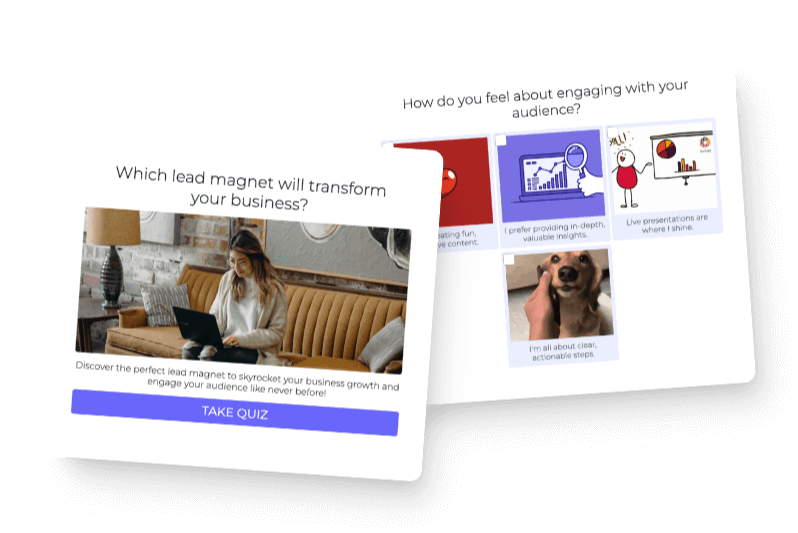

Quizzes for email list growth in 2026 tend to have some commonalities, and I’d like to highlight those by giving concrete examples of what is working for quiz lead magnets right now and then draw out the similarities between all of them.
1. Advice with Erin’s Career Type Quiz: 140k email subscribers.
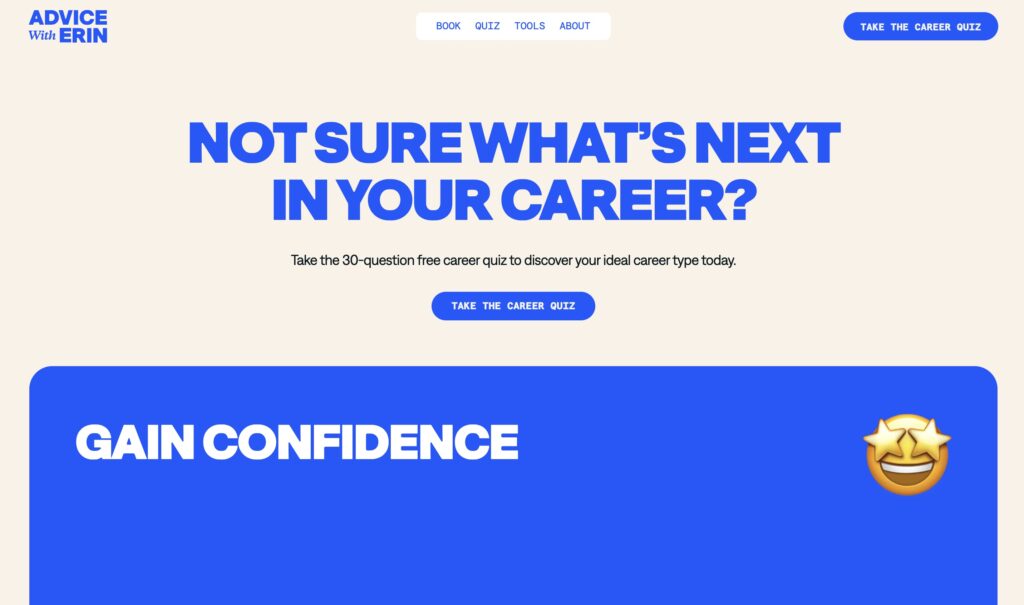
This quiz has added over 140,000 email subscribers to Erin’s email list and it continues to run. I wanted to start with it as an example because it’s a quintessential use of a quiz to convert an audience into email subscribers in a way that’s beneficial all around.
I interviewed Erin for the Interact Podcast, and she gave the clearest explanation of how the quiz came to be, and why it works so well. In summary, people kept asking her what career they should pursue because something felt “off” about their current career path. They would DM this question because it required an individual answer.
There is no one size fits all solution to the question of “What career is best for me?” However, as she answered that question 1000’s of times, she started to see a pattern in the answers she was giving, and that pattern started to emerge into 6 career archetypes that covered almost all of the people who would ask the question. So she turned those archetypes into quiz results, and then worked backwards from there to create the questions of her quiz that help people find their ideal career type.
This example shows that in their best form, quizzes in 2026 that effectively grow your email list answer an important question for your audience that can only be answered in a more individualized way, where there are a set number of archetypal answers you can group people into to give a helpful path forward for the quiz taker.
2. Dr. Morgan’s Attachment Style Quiz: 40k Email Subscribers.
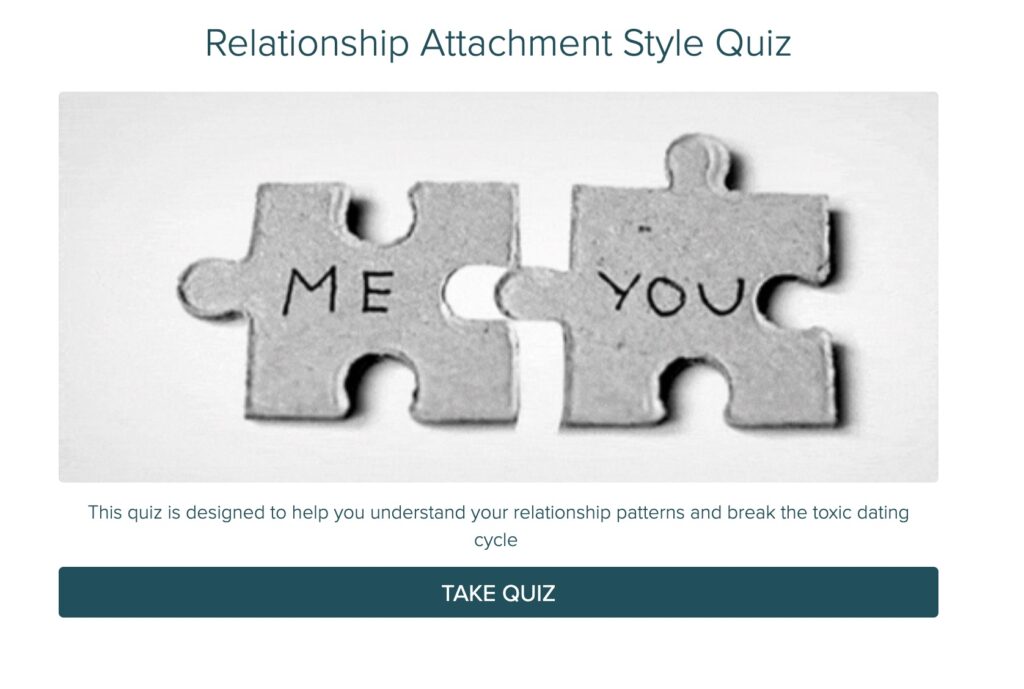
This quiz has added 40,000 subscribers for Dr. Morgan, on autopilot, since 2020 when she launched it. In our interview she said she hasn’t needed to modify the quiz since then, because it’s based on attachment theory, which is a long-standing concept.
That point is super important, because the quizzes that are working well for email list growth in 2026 are often built on long-standing frameworks. There is attachment theory, personality theory, enneagram, myers-briggs, or some other framework that helped inform the quiz itself. Of course each one is from the mind of the creator and not directly drawing from these copyrighted frameworks, but the creators of top quizzes have studied the theories underlying personality, archetype, and psychographic, frameworks.
In this moment where so much is changing, which to some extent we are always in, people are gravitating towards systems and frameworks that do not change. Importantly, and Dr. Morgan’s quiz is an excellent example of this, you have to personalize it with your own way of speaking about things. Your own way to presenting the frameworks, that is individual to the way you work with people. This is informed by your conversations with customers who you have successfully helped in whatever area your quiz is addressing.
That pairing of a long-standing framework with your unique approach is another key to successful lead magnet quizzes in 2026.
3. Jamie Sea’s Visibility Quiz: 25k Email Subscribers.
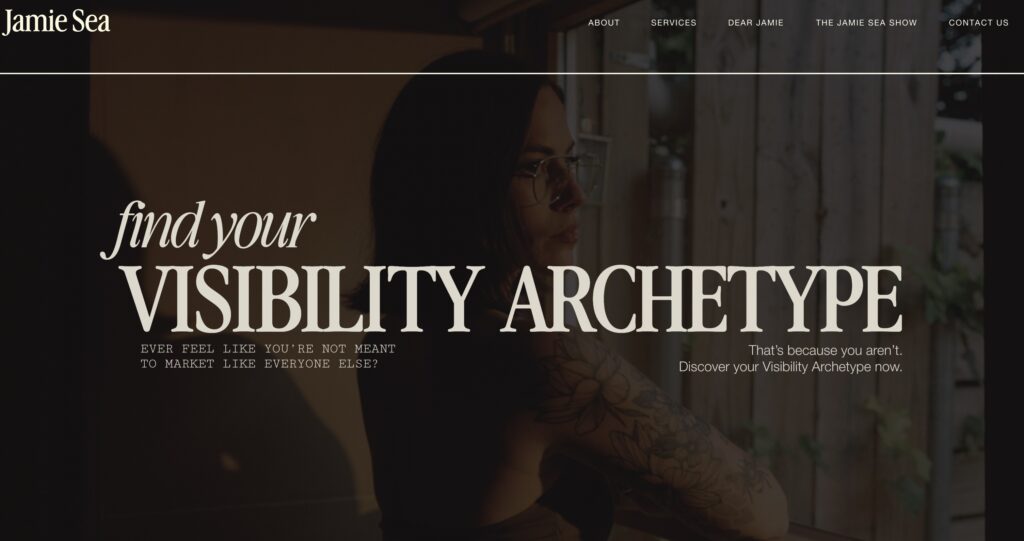
What I want to highlight with this quiz is the attention to what the audience wants. Jamie’s quiz focuses specifically on visibility for business owners. A topic that is hotter than hot in 2026, because everyone is trying to navigate the shift to video and social media as the primaries methods for becoming visible online.
Her quiz uses archetypes, as previously discussed, but it also uses a lot of language that makes people feel seen in their struggle to become visible in this new world of interest-based, short form video, social graph, content. She speaks directly into the world of the audience, meets them where they are, and helps guide them towards what they want, which is to become visible online so they can grow their businesses.
The important point here is your quiz has to meet people where they are and then guide them to where they need to go. Often times those are different things. In this case, part of the story is that people want to become visible, but what they need is to get over mental blocks around being seen. So it starts off by addressing what the people want (To become visible) and then in the recommendations at the end helps address what they need (To address mental blocks).
Interlude: A strategy shift in 2025.
I would like to stop here and take note of a distinct strategy shift that happened in 2025. The above 3 examples were driven almost exclusively by Instagram Reels that drive people to quizzes through a DM automation (more examples of that type of setup here). Those quizzes are also featured on websites, mentioned in podcasts, and in link-in-bio, but when interviewing the creators of those quizzes, they say that the vast majority of the email subscribers that come in through those quizzes are from Instagram Reels with the DM automation turned on (so you can comment “Quiz” and Manychat or a similar tool will DM you the link to the quiz).
I’ve been running Interact for 14 years, and that is the sharpest turn I’ve ever seen in terms of where people are finding out about quizzes. Prior to that, it was a majority on websites, but with the shift towards social mobile video and with AI taking over the lion’s share of search instead of people going to websites, the change happened almost overnight.
But it’s a very interesting dichotomy, because there are still quizzes that get a lot of search traffic, and convert website visitors, in addition to the social-first approach. I don’t want to leave those out and over-index on just the new strategy, but I do have to highlight the difference between quizzes that got popular in the 2010’s versus after 2025. In the 2010’s many quizzes got established that still get great traction on other channels, but that’s generally not the case for new quizzes being launched. However, the older quizzes can be repurposed for the Instagram Reels approach if that makes sense. So I want to highlight a few examples of those quizzes that started out in the 2010’s and still deliver great results today, to highlight the longevity of quizzes as an email list growth tool across multiple channels (website, podcast, YouTube, Link-in-Bio, Instagram, TikTok, LinkedIn).
Jenna Kutcher’s Multiple Quiz Approach: 100k+ Email Subscribers.
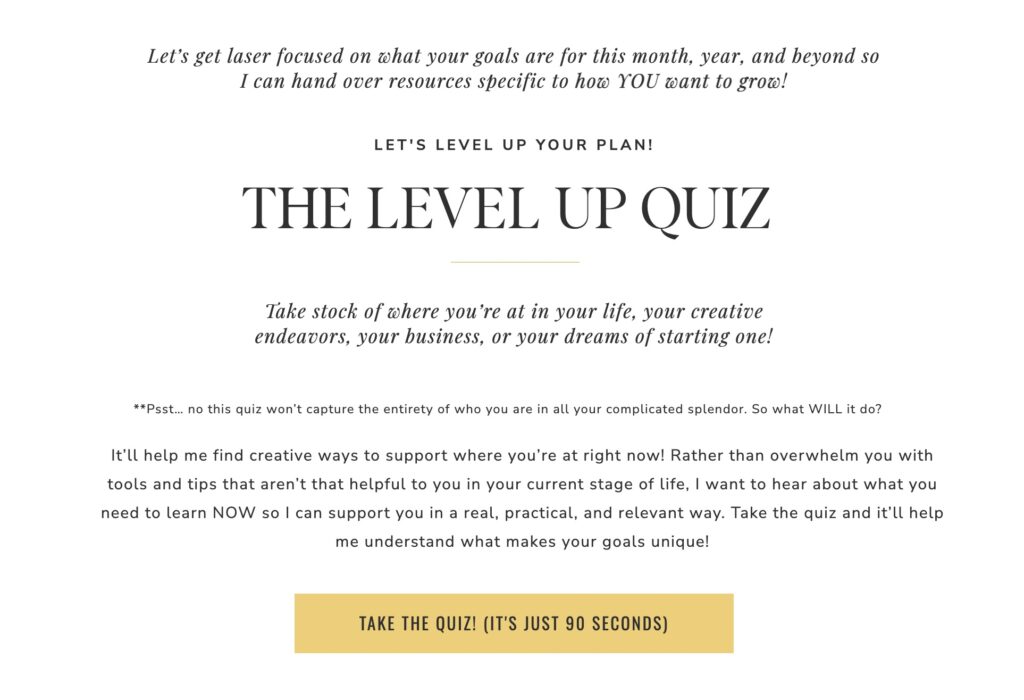
I’m truly grateful to Jenna, she’s pioneered quiz strategy since 2018 and has successfully implemented multiple quizzes across different audience needs. I want to highlight this approach because it shows the effective use of quizzes as a way to meet audience needs across different areas they are interested in learning about.
It started in 2018 with the Secret Sauce Quiz, this was a pivotal moment in quiz history. If you ask anyone in the entrepreneurial space about this quiz, they probably know what you are referencing. It was one of the first examples of a quiz becoming a truly iconic asset on its own, and really showed how you can make something that is fun and exciting (Finding Your Secret Sauce) into something that also is highly effective for email list growth (Over 100k email subscribers).
And that’s the point I want to draw out from Jenna’s examples. You can create quizzes that are meant for different parts of your audience, that are specific to the wants and needs of different types of people who come to you for help and advice.
5. Gretchen Rubin’s Flagship Four Tendencies Quiz and Multiple Quiz Approach: Top Driver of Discovery
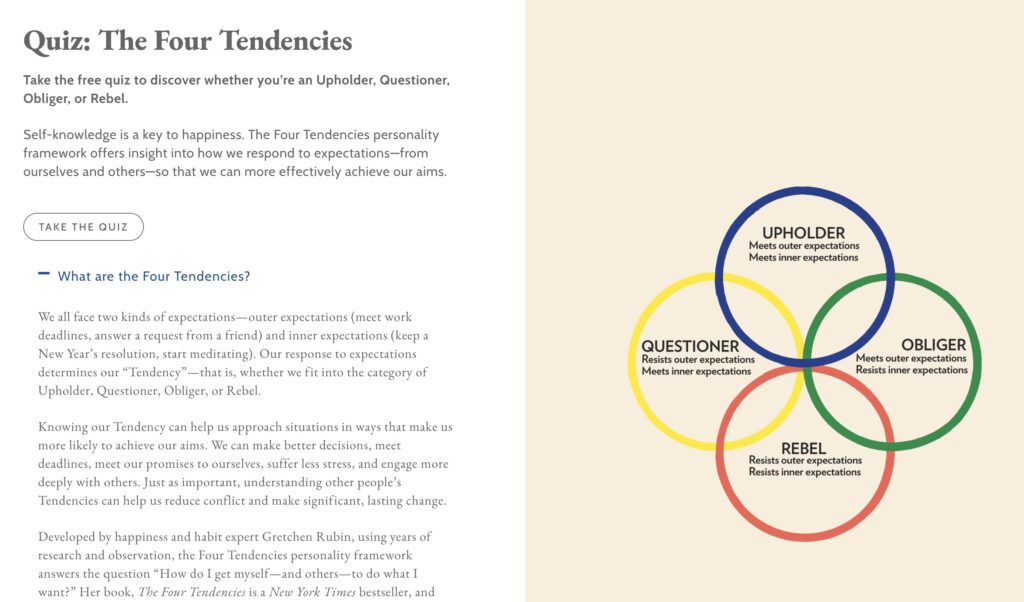
Gretchen Rubin is a 8-time NYT best selling author. Her flagship Four Tendencies Quiz has been featured on many top podcasts and news outlets. But Gretchen also creates quizzes for specific parts of the year, like here New Year Habits Quiz.
These quizzes are so well done they are timeless. Before we started Interact, I studied the history of quizzes, and they operate on roughly a 10-year cycle, meaning every 10 years the same quizzes re-rise in popularity. Gretchen’s quizzes are the type that will resurface across multiple cycles, they are that timeless and great.