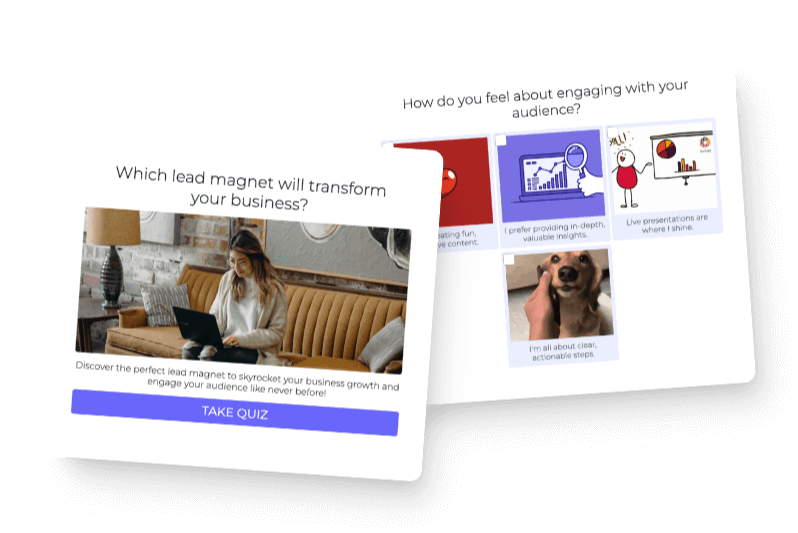

Here in-lies the biggest bottleneck to adopting quizzes for email list growth. The knee-jerk reaction from the vast majority of people, even seasoned creators with millions of followers is “what kind of quiz should I make? I have no idea where to start.”
A few years back, I wrote the backend prompt for Interact’s AI Quiz Maker, which has helped answer this question for thousands of people, but we’re now circling back around where people want more, they want a deeper answer to the question, and I’m all for it.
This advice comes from what’s working right now, May 15th 2026, which I want to call out because so much has changed recently. The advice comes directly from the most successful quiz creators. These are creator entrepreneurs, using quizzes to drive conversions from Instagram, YouTube, and Podcasts, into their email lists, where they are building their own businesses. I feel that’s important to qualify, because without your own business on the backend, building an email list is a fruitless enterprise, and a quiz lead magnet is worthless.
With your own business on a backend, where you’ve got a regular newsletter that goes out, and products/services of your own you can monetize, a lead can be worth $5-10, which makes a quiz that brings in 100’s or 1000’s of leads a month a money printing machine.
This is the case with the folks I will highlight throughout this piece, and I’ve spoken to all of them on our podcast.
1. The number one, most important thing, about successful quiz lead magnets
They help the audience with something the audience wants help with. I’m sorry to sound so trite, but audiences only care what they care about. They don’t care what you want to help them with. And that’s the biggest point of contention I experience when trying to walk people through quiz setups.
Here’s the issue. You build your business around a solution that actually helps people. Which is incredible. But people don’t want it. They do want the results, but they are asking questions that are so far removed from what you actually help with, there’s a canyon of a disconnect so wide it’s like the grand canyon times a million.
Can you tell I’m upset by this? Because in the last 13 years I’ve struggled immensely trying to reorient people to think about what their audience wants, as it pertains to what their businesses actually offer.
My favorite example of this is an inner work coach. Someone who helps unpack all the issues and fears that lie deep inside a human’s brain, that hold the back from reaching their full potential. I spoke with one such person who has a library of knowledge on the subject, and can be so helpful to their audience. And this coach was complaining that all anyone ever wants is to “Figure out how to be more productive in the afternoon hours” and the coach was raging because the real answer to why you’re not productive in the afternoon hours is because of some deep-seated trauma from your childhood. The coach was annoyed because if people could just understand that was the case, they would be able to improve their productivity.
Incorrect. You will never win that battle. You know the quote “If you want to get what you want, give other people what they want?” that applies here in spades. You have to first give people what they want, which is a simple answer to the question of “Why can’t I be more productive in the afternoons?” Then, once you’ve satisfactorily provided an answer to that question, you can slowly start to introduce some ideas pertaining to the fact that their could be something deeper going on that’s leading to the productivity mismatch.
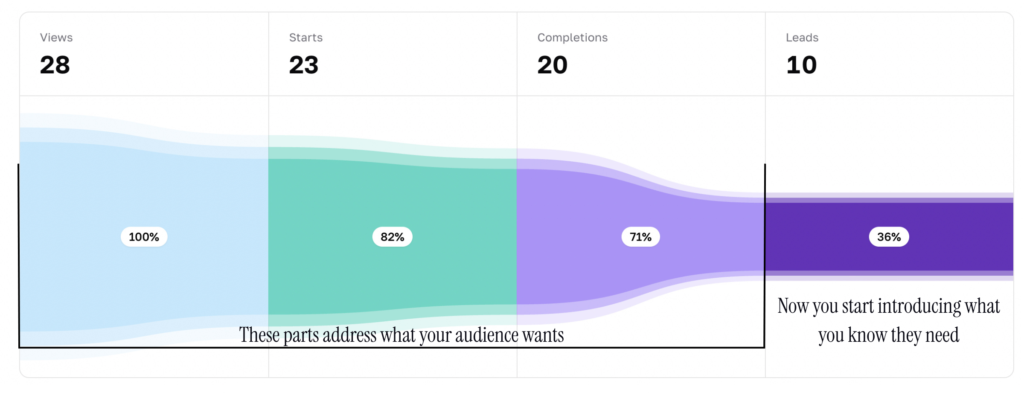
In this graph here of quiz analytics, I’ve highlighted how this works. The entire quiz, the cover page, the questions, the results, address what the audience wants to know for themselves, which quizzes are great at. It’s only after you collect their email address that you slowly start to sprinkle in what you know they need.
2. The best Quiz Ideas are Still the Simplest Ones
With that framing, I now want to make an aside and share that the highest performing quizzes, that drive the most leads and sales, and stand the test of time, are also the simplest ones. And there are only a few quiz formats that consistently work well. They are as follows.
- What Your (Blank) Type? also phrased as “(Blank) Type Quiz” and “What Type of (Blank) is Right for You?” – This quiz format assigns people a “type” based on how they answer the questions of the quiz. It uses personality quiz logic.
- Examples are: “Career Type Quiz” “Visibility Archetype Quiz” “Four Tendencies Quiz”
- “Am I a (Blank)?” – This quiz format is a scored quiz where if you answer above a certain score you are the blank, in the middle you might be, and at the bottom you are not.
- Examples are: “Am I a Highly Sensitive Person?” “Am I Suited to Start my Own Business?”
- “(Blank) Assessment” – This quiz format can be either personality logic or scored logic, and the word “Assessment” sets the table for people to measure themselves against the topic of the quiz.
- Examples: “Ayurvedic Body Type Assessment” (Personality Logic) “
That is it. And I’m adding this section because next we will go through how to connect the first part, which was a very long diatribe about how you can think about quiz concepts, to the second part, which is what actually ends up being shown to your audience, and is extraordinarily simple.
3. Connecting a heady quiz concept to a simple quiz Title your audience will respond to
In section one we went deep on how to think about a quiz concept. In section 2, we flipped completely to the simple formats of quiz titles that work the best. Now I want to connect the two.
First, you’ll want to think about what people keep coming to you for help with. It’s the DMs that tell the story here. What do they constantly ask you? What do they come up to you after talks and ask you? What do they ask you on podcasts? or in the comments? What’s the question that keeps coming up, despite the fact that you’re answering that question in your content?
I truly wish I could be more prescriptive with how to identify this question your quiz can answer. But it’s an intuition thing. Quantitative data can help, documenting every question someone asks you, and ranking those. But when I speak to people who have truly great quizzes, it’s often the qualitative that wins out. It’s reading between the lines to know what people are really asking you. What they really want to know. That maybe they’re too embarrassed to admit, or not quite self-aware enough to realize. It’s the second-order question that lives just behind the veil of consciousness that really cuts deep and gets right to the heart of what your audience truly wants help with.
There, didn’t I say I’d make this simple?
Okay, now here’s the trippy part of this whole process. Right when you’ve gone all the way down the rabbit hole, you’re going to do a complete 180 and turn that super deep question into one of the simple quiz formats in section 2.
Why? Because your quiz has to appeal to first-order thinking. To the scrolling mind. To the distracted energy of someone watching reels while also watching TV while also making dinner while also talking to a friend. That’s who you are reaching in our world today. So you can’t make it complicated.
But, because you’ve done the work of diving all the way into the psyche of the person taking the quiz, it will immediately ring a bell, wake someone from their slumber of multi-tasking distractedness, shake them to life, and capture their attention to take your quiz.
That’s why you have to have both. There has to be both the immense depth of thinking about what quiz idea will resonate at a core level with your audience, and the simplicity to stop the scroll.
Conclusion: Shoot from your (deeply knowledgable of your audience) hip
It’s kind of like the makeup artist who you only have to say three words to, and they absolutely nail your look. That doesn’t come from anything other than thousands of repetitions and more customer feedback than any one person should have to endure in a lifetime. Your business is the same way. You hear it from your audience every single day, and if you can run that deep knowledge through the filter of this framework above, you will come out with a highly successful quiz that builds your list for years to come.