

Great questions build trust. Bad questions break it. Here is what I have learned from the questions people have asked across more than 100,000 quizzes built on Interact.
How to ask great questions is especially important in the context of lead magnet quizzes, but honestly, this applies to any sort of question that you might be asking. The purpose of asking great questions is to build trust, and building trust is one of the most important things in growing a business. You can’t grow a business if you don’t have trust with your audience.
After researching questions on over 100,000 quizzes that have been built on the Interact platform, viewed over a billion times, and generated 100 million leads, these are the most important aspects I have found in terms of how to ask great questions. These quizzes have had a lot of opportunities to either build trust or lose it. The patterns are actually pretty simple.
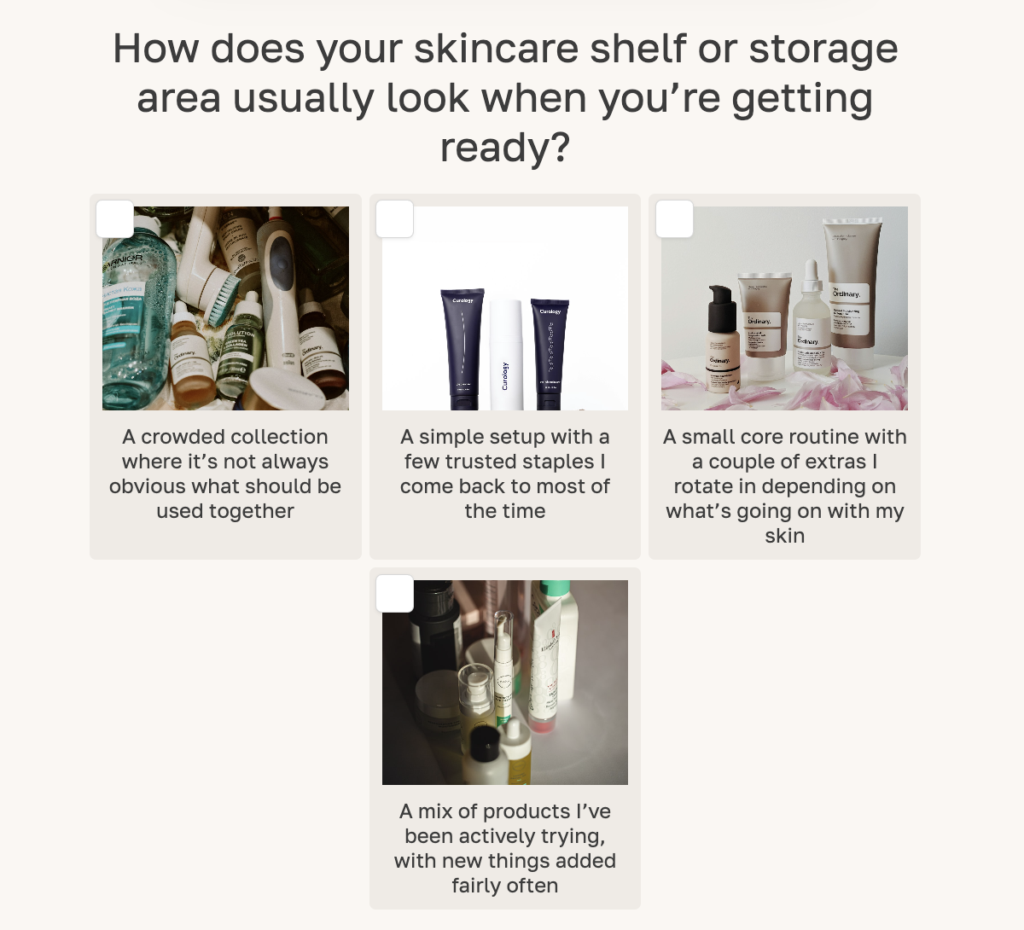
Start with the logistics
The first thing that I want to highlight in terms of how to ask great questions is the logistics, because everybody asks me about the logistics. So just to get this out of the way, you want somewhere between five and 40 questions. Specifically, where most quizzes fall is within the range of six to 10.
The reason why you could have a lot of questions or fewer questions is because sometimes you need that in order to satisfy what your quiz is supposed to do. So don’t feel like you have to follow some sort of best practice if you know that your quiz specifically needs 35 questions. Don’t fall for that. But generally, if you’re just coming into this cold and it is your first time, somewhere between six and 10 is right.

Every question should ask about something different
The second logistical thing is that every single question has to be about a different topic. I got to interview Ye Li, who is the head of behavioral science at UC Riverside. What he said when I interviewed him was that they did some research on asking questions and found that people start to stop paying attention once you ask a similar type of question multiple times in a row.
So if you keep asking very similar questions, people will stop paying attention and stop actually answering the questions. They’ll just go into autopilot. That is very bad, especially if you’re using this for a lead magnet quiz, because you want people to get to the end. At the end is where the opt-in form is, and if they don’t get to the end, you won’t get any leads.
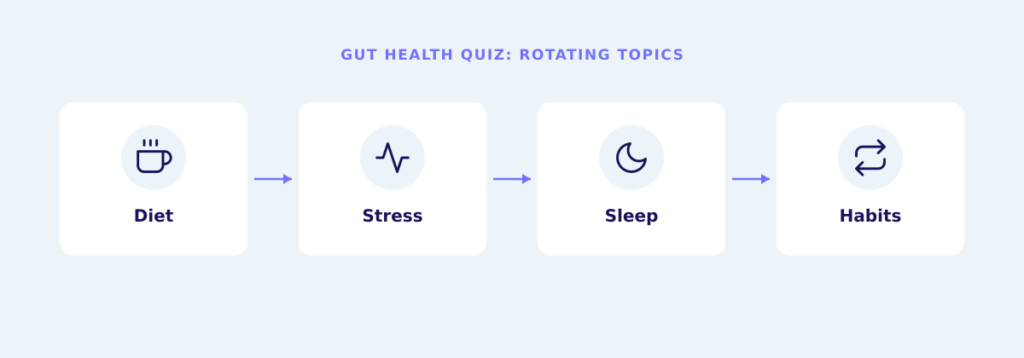
Instead, what you want is every question to ask about a different topic. So for example, if you’re doing a gut health quiz and you’re trying to figure out somebody’s root cause of their gut health issues, do not ask 10 questions in a row about their diet. Ask a question about diet, then ask a question about stress, then ask a question about sleep, then ask a question about habits. Make sure that it varies, because otherwise you will lose interest.
Ask questions that prove you know your audience
The third thing, which is no longer logistical but more about how you ask the questions, is that the questions need to come across in a way that demonstrates very explicitly that you know your audience. The fastest way to build trust is to ask the right questions. The fastest way to break trust is to ask the wrong questions.
If you ask the questions in the wrong way, or you ask about the wrong things, you will immediately break trust with your audience. People want to know that you understand their world, and there is no faster way to demonstrate that than by asking a question that is so specific to their world that they immediately understand that you understand them. Then they feel seen, and that builds trust.
A great example of this came up when I interviewed Erin from Advice with Erin. She was talking about how one of the questions on her career-type quiz asks how important money is to you in terms of your career. But instead of just saying, “Does money matter to you?” because everybody is going to say yes, one of the answer choices says, “Making more money than my peers is very, very, very important to me.”
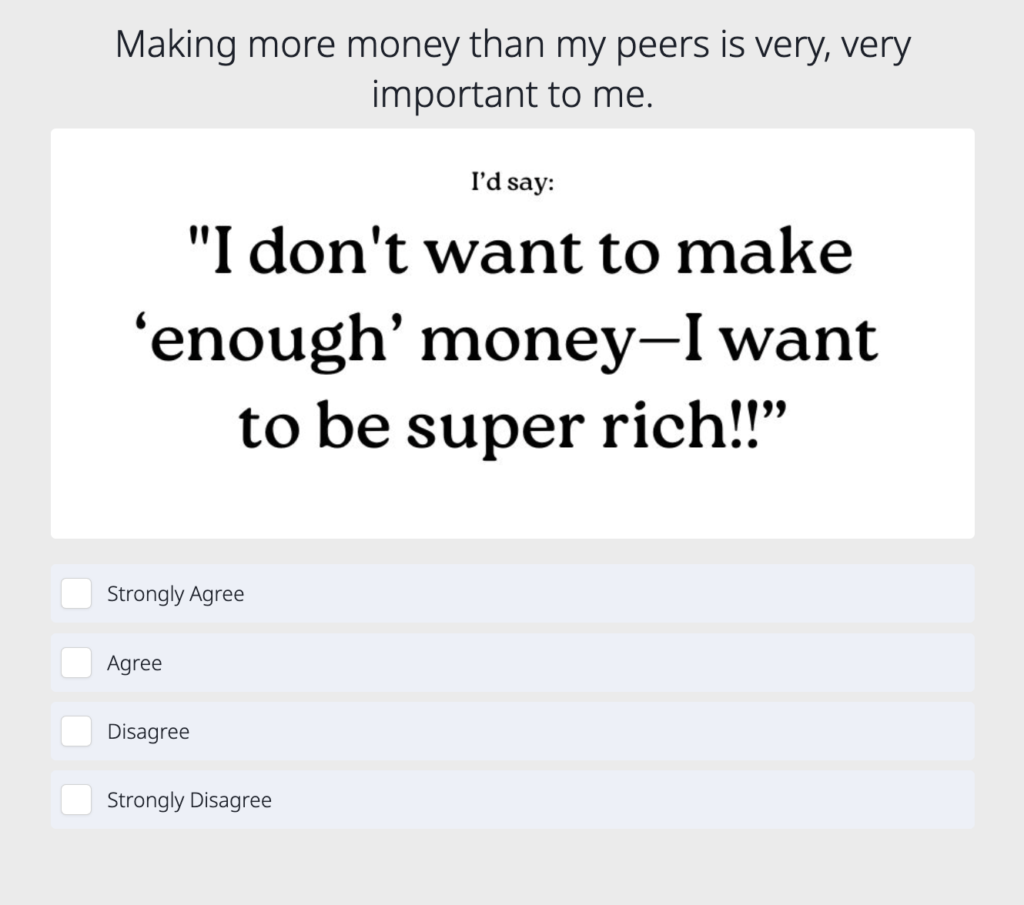
That makes the question super specific. If you are somebody who feels like making more money than your peers is very, very, very important to you, that question and the way that it is framed is going to immediately make you think, “Oh yeah, that’s me. They understand me.” And that is huge.
You have to have that. That is absolutely vital in order to make your question asking effective. Effective question asking gets people to feel like you understand them because the questions are written in a way where people immediately understand that you know their world.
Keep the quiz logic simple
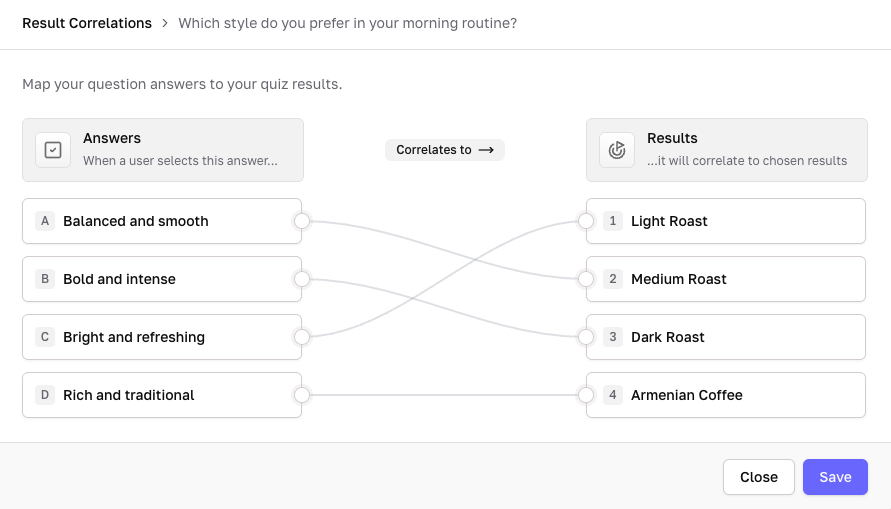
In terms of the logic and the logistics of this stuff for quizzes specifically, I like to ask questions where there is an answer choice that represents each of your quiz outcomes. That way it’s easy. You just draw the lines: this answer choice goes to this outcome, this answer choice goes to this outcome.
You want to mix those up so it’s not always exactly the same, like every answer A goes to outcome A. Mix it up so that people don’t get bored. Again, if the structure is the same every time, people will start to see the pattern and go into autopilot.
The three things that matter most
Those are the top three things that are actually really important about asking great quiz questions and great questions in general. One, you want somewhere between six and 10 questions, although anywhere between five and 40 is fine depending on your specific situation. Two, each question should ask about a different thing so that people don’t get bored.
And three, each question should be written in a way that demonstrates that you exactly understand the audience the question is being asked to. That is the fastest way to fast-track yourself to immediate trust. And when the quiz is being used as a lead magnet, that trust is what keeps people engaged, gets them to the end, and gives them a reason to opt in.