
Obviously, the biggest bottleneck is always going to be around acquiring customers. And that usually comes down to messaging, what you say not landing with who you want to reach. The next place things get stuck is in pathways for personalization.
You either spend too much time with everyone, which means you waste time, or you spend too little time with the right people, which means you aren’t capitalizing on the legitimate demand you have.
That is where I would start when creating a personalized customer journey. Get clear on what brings the right people to you, then decide how to respond to the different kinds of help they need. A quiz can make that second decision easier by asking questions before recommending the next step.
Start with the message that brings people in
Before building different pathways, look at what you are saying to the people you want to reach. Can they recognize their situation in your message? Can they see how you could help? If that connection is missing, adding more steps to the journey leaves the original problem unresolved.
Listen to how people describe the problem when they contact you. Look at the questions they ask before buying and what they say they want to change. Use that language to make the invitation into your business more specific.
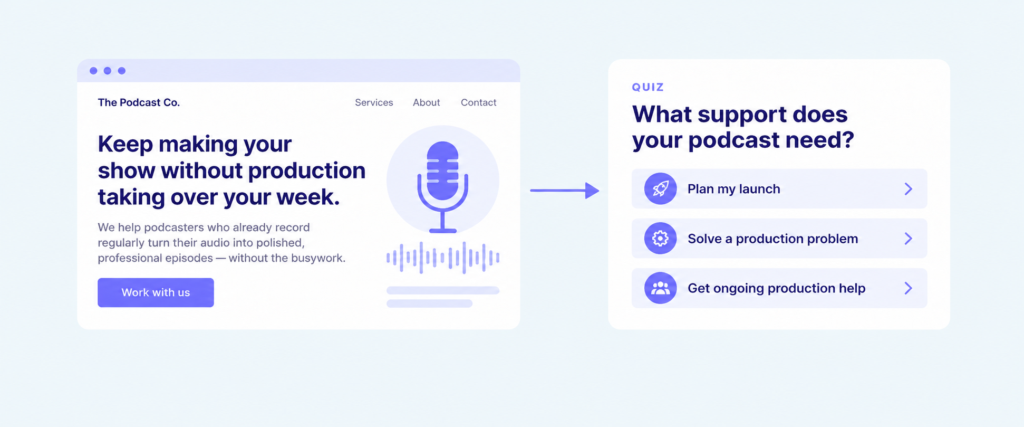
For an illustrative example, imagine a podcast production agency whose ongoing service is designed for hosts who already record regularly. Its intended customer might say, “I want to keep making the show, but producing every episode is taking over my week.” A message about getting episodes produced without doing all the work yourself speaks to that situation. The quiz can then help the host figure out what support makes sense.
Decide where personal attention makes a difference
Now look at the conversations you are having. Which questions come up repeatedly and can be answered clearly with a resource? Which situations require you to understand more before making a recommendation? That distinction helps you decide where to spend time.
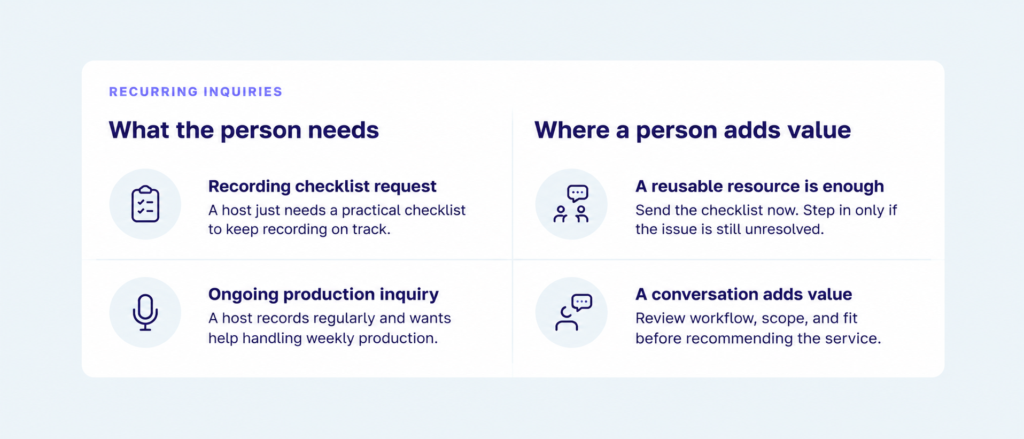
Someone looking for a recording checklist may be able to move forward as soon as they find it. A host deciding whether to hand off weekly production may need to talk through the workflow, scope, and expectations. Both deserve useful help, but the help takes a different form.
Review the other side of the problem too. If a suitable customer has described a real need, a general email sequence may leave their specific question unanswered. A personalized journey should make it easier for that person to get the conversation they need while letting straightforward questions receive straightforward answers.
Define the useful next step for each situation
Create a small set of pathways based on the situations you can actually help with. Write down what someone needs, what would move them forward, and when a team member should become involved. Start with the next decision in front of the person, then build the journey from there.
For the podcast agency, the following paths are illustrative. The agency would adapt them to its actual services and capacity. A person’s stage is relevant here because the ongoing service assumes they already record regularly.
| Person’s situation | Useful next step | Personal attention |
|---|---|---|
| Planning a first show | A launch planning resource that helps them prepare. | A way to ask if they need something the resource does not cover. |
| Recording, with a narrow question | A relevant checklist or tutorial for that problem. | Help if the specific issue remains unresolved. |
| Recording regularly and seeking ongoing production | A service overview and a focused consultation. | Review their workflow and discuss whether the service fits. |
| Unsure what support would help | A short way to describe the situation in their own words. | Review the uncertainty before recommending a path. |
The important decision is what happens next. A person planning a show may become a suitable customer later, and an established host may only need a resource today. Use their current need alongside their stage so the journey reflects what they are asking for.
Use the quiz to understand which path will help
Give the quiz a question the person wants answered. In this example, “What support does your podcast need?” creates a reason to share what is happening. The outcome should help them understand their next step, including when that step is a resource rather than a consultation.
Ask questions that help you make that recommendation. For the agency, three starting questions could be:
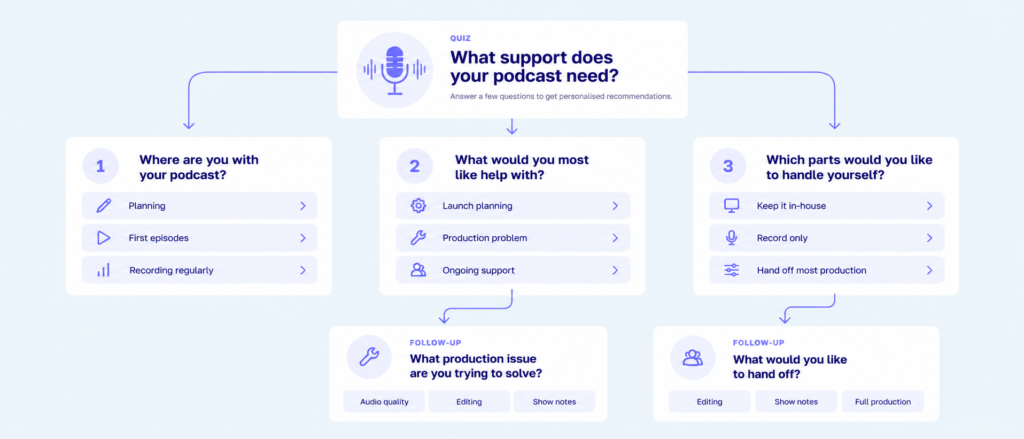
- Where are you with your podcast? Choices could cover planning, recording initial episodes, or recording regularly.
- What would you most like help with? Choices could cover planning a launch, solving a specific production problem, or handing off ongoing production.
- Which parts would you like to handle yourself? Choices could range from keeping the whole process in-house to focusing on recording and handing off the rest.
Use follow-up questions where the answer changes the advice. Someone with a specific production problem needs a chance to identify it before you choose a resource. Someone considering ongoing support may need questions about the work they want to hand off. Give uncertain answers a path to clarification too.
Connect the recommendation to the right level of help
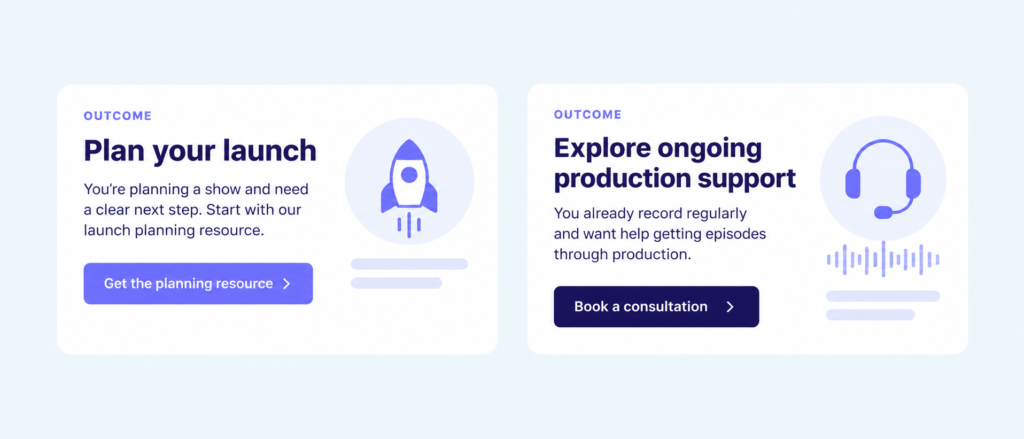
In Interact, branching logic can use an answer to determine the next question or send someone to an outcome. For this example, it can separate launch planning, specific problems, and ongoing support, then ask relevant follow-ups. Map every answer path to an outcome before sharing the quiz.
Explain why the next step fits. An outcome for an ongoing production inquiry might say, “You already have a recording rhythm, and you want help getting episodes through production. The next step is to look at which tasks you want to hand off and how the workflow would run. Our consultation gives us a chance to work through that together.”
Each outcome can have its own call to action button. Point it to the appropriate resource, consultation booking page, or short inquiry form. Someone still needs to complete the booking or inquiry; reaching the outcome does not complete that step for them.
Make the human conversation count
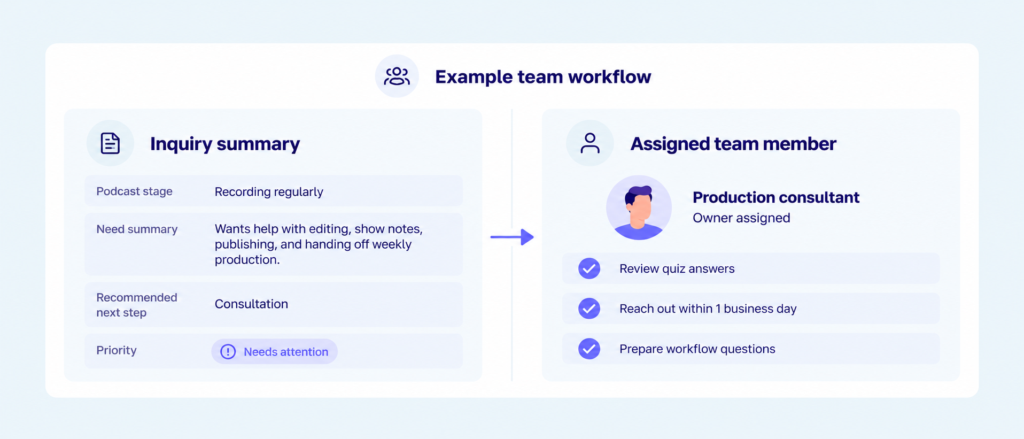
When someone does need a conversation, make sure the person responding has the relevant context. In the agency example, that means knowing the host already records regularly and which production work they want to hand off. The conversation can then focus on details that require judgment.
If you collect contacts in the quiz, Interact’s email integration actions can organize subscribers by outcome. The available fields, tags, lists, and answer-level actions depend on your integration. Choose the information you will use, then arrange your team’s process so the relevant person can review it before responding.
Decide who will handle suitable inquiries and how they will know one needs attention. A tag alone does not create that responsibility. The agency needs someone to review the inquiry, address the host’s question, and follow through on the conversation the pathway promised.
Check both sides of the bottleneck
Look for signs that the pathways are helping. Are common questions being answered without repeated conversations? Are suitable inquiries getting timely, useful attention? Is the team spending more of its conversation time on questions that need its expertise?
Review the people who ask for a different path or say their recommendation missed the point. Their feedback can reveal an unclear question or a situation you have not accounted for. Keep a visible way to ask for help, and let people’s current needs update what you learned about them earlier.
Evaluate sales alongside the time spent helping people, using your booking, sales, and team records. Fewer calls alone would miss the goal if suitable customers also stopped moving forward. The aim is to answer straightforward needs efficiently and make room for the personal attention that legitimate demand deserves. Create your quiz with Interact.