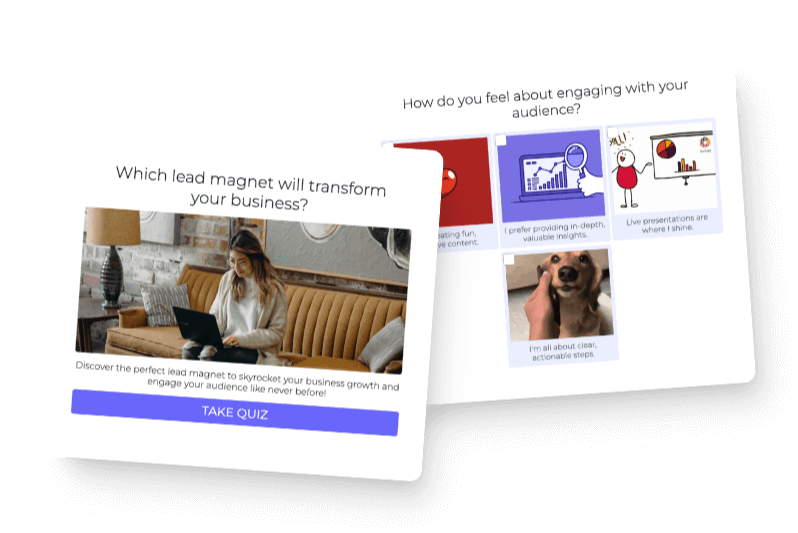

I’ve been thinking about quizzes as a way to keep a business running while the owner is offline.
The first phrase that came to mind was “creator operating system.” I still think that’s basically what is happening, but it makes the idea sound much more complicated than it needs to be. Most people aren’t looking for an operating system. They’re trying to stop answering the same question manually every time somebody new finds them.
And I think this is where quiz funnels have gotten a little out of hand.
When people hear quiz funnel, they picture a whole system: a dozen outcomes, perfectly branched emails, a custom resource for every result, a product at the end of every path, and all of it mapped before the quiz can go live.
You can build that. But you don’t necessarily need any of it for the quiz to be useful.
A quiz can just answer one question.
Not a question that’s trivial. A question that looks relatively simple on the surface but is actually painful for the person asking it:
What career is actually right for me?
Which car should I buy for my family?
Where should I start?
Which option fits my situation?
Those are short questions. They aren’t small questions. They can involve identity, money, time, uncertainty, and the fear of making the wrong choice.
People take the quiz because they want that answer for themselves.
The value is the answer
This is the part I think gets reversed in a lot of marketing.
The business is thinking about the email address, segmentation, the sequence, and eventually the sale. The person taking the quiz is thinking, “Can you help me figure this out?”
That self-interest isn’t a problem. It’s the reason the whole thing works.
Once you realize that a large part of your audience faces the same challenge or keeps asking some version of the same question, you have the beginning of the quiz.
You figure out the different answers you know would be satisfying or helpful. Then you work backward and ask the questions you need to determine which answer is most useful for that person.
At that point, you’ve essentially built a recommendation engine. Or a personalized guide. Or a quiz. Whatever you want to call it.
And it doesn’t necessarily need to lead directly to a product. The value can literally be the answer itself. The quiz can give someone direction, recommend a resource, or narrow a decision. Then, if they want to keep hearing from you, they can join your email list.
That makes the exchange feel much more mutual. They get something they genuinely wanted. You get permission to continue the relationship.
What the quiz can do while you’re offline
“Keeping your business running while you’re offline” doesn’t mean your business becomes some giant automated machine that never needs you.
It means one useful conversation no longer has to wait for you to have it manually.
The quiz can be there to greet someone who just found your site. It can answer a frequently asked question. It can guide someone to the right content, product, service, or next step. Or it can simply give them a useful answer to a question they were already thinking about.
That’s enough.
If the person shares an email address, then you can begin the much longer process of building a connection through the emails you send. Some people will eventually buy. Many won’t buy right away. That’s fine. The quiz didn’t fail because it didn’t close the sale on the result screen.
Its first job was to help.
Advice With Erin: start with the recurring question
The Advice With Erin example makes this very clear.
Erin McGoff’s audience kept asking some version of, “What should I do with my life and career?” After answering that question over and over, she started to see recurring patterns in the people asking it. Those patterns became six career profiles, and then she worked backward to create the questions that could guide someone to the right profile.
That sequence matters.
She didn’t start by asking, “What questions would be fun in a career quiz?” She started with the answers she already knew were useful because they came out of real conversations with her audience.
Interact’s April 2026 case study reported that the quiz had generated more than 140,000 email leads. You can hear Erin explain the thinking behind it in her Interact Podcast episode, and you can also take the Career Type Quiz yourself.
The lead number is impressive, obviously. But I think the more transferable lesson is that the audience had already told her what it wanted to know. The quiz made that answer available to a lot more people without Erin needing to answer every DM herself.
The Car Mom: a simple question with a lot underneath it
The Car Mom example works for the same reason.
“Which car should I buy?” is a very simple sentence. But buying a family car is not a simple decision. It’s expensive. It affects daily life. There are safety considerations, car seats, space, budget, and a huge number of vehicles that look roughly interchangeable until you know what matters.
Kelly Stumpe was already helping people answer that question through her content and paid consultations. She turned that expertise into a roughly seven-question branching quiz that recommends one car first, with the option to look at similar choices afterward.
Interact’s case study says it became The Car Mom’s top email-list growth tool. Kelly also talks about the quiz and the larger business on the Interact Podcast. You can open the live family-car quiz from The Car Mom’s site.
Again, the quiz doesn’t have to sell the car. It helps someone narrow an expensive, overwhelming decision. That’s real value on its own.
And this is what I mean by the business running while you’re offline: one of the most common and useful conversations in the business is available whenever the person needs it.
Why people want this kind of answer
There are a lot of questionable internet statistics about how much of the day people spend thinking about themselves. I don’t think we need one of those to make the point.
The more useful research is the self-reference effect. A meta-analysis found that people tend to remember information better when they process it in relation to themselves.[1] That’s pretty close to what a good quiz asks someone to do: think about their own preferences, situation, or behavior and then receive an answer that connects those inputs to a useful result.
Curiosity research gives us another part of the explanation. Once the gap between what someone knows and what they want to know becomes specific, people are motivated to close it.[2] “I’m confused about my career” is broad. “Which career type am I?” is a question with an answer on the other side.
There’s also research on choice overload, although I think it’s important not to overstate it. More options aren’t always worse. But a meta-analysis found that overload is more likely when the choice set is complicated, the decision is difficult, or the person isn’t sure what they prefer.[3] That describes career choices and family cars pretty well.
So the reason this works isn’t really that people want “personalization” as an abstract feature. They want help with their question. Personalization is the mechanism that helps you give them an answer that fits.
The email is an invitation to continue
The email part can be much simpler than people think too.
You can ask for an email before the result. You can make it optional. You can show a useful answer immediately and offer a deeper result by email. The exact structure depends on the business and the question.
The important part is that the exchange feels fair.
The person is giving you attention, information about themselves, and possibly an email address. You’re giving them clarity. If the answer is actually helpful, the invitation to stay connected makes sense.
You also don’t need a perfectly branched 18-email sequence on day one. You can send the result, welcome them, and then keep sending useful emails. Over time, that connection may turn into revenue.
I think this is a healthier way to think about conversion. Revenue is still the business goal. We don’t need to pretend otherwise. But you don’t have to force the entire conversion into the moment someone finishes the quiz.
You can help first and keep the conversation going.
How to find the question your quiz should answer
The key unlock is knowing what people want the answer to.
Start with the places where people are already talking to you: DMs, comments, customer calls, support emails, intake forms, podcast feedback, and the questions people type into search.
Then ask:
- What question do people ask me over and over, even when they phrase it differently?
- Which question looks simple but is actually painful, expensive, emotional, or difficult to answer alone?
- What answer patterns do I already see?
- What is the minimum information I need from someone to know which answer will help them?
- Would the result still be useful if the person never bought anything?
You may end up with three results. You may have six. You don’t need twelve just because a quiz can support twelve.
You may also discover that the result doesn’t need a perfectly curated library of resources behind it. It may need one clear explanation, one recommendation, and one reasonable next step.
Build the smallest version that gives a satisfying answer.
Start with the question, not the funnel
If you’re trying to create a quiz, I wouldn’t start with the software, the branching logic, or the email sequence.
I would start with this:
What is the one question my audience keeps asking that sounds relatively simple, but isn’t actually simple to them?
Once you know that, you can create the different answers. Then you can figure out the questions that help you match each person to the answer that will be most useful.
And then you have it. You have the quiz, the recommendation engine, the personalized guidance – whatever you want to call it.
It can sit on your website and be helpful while you’re offline. It can capture an email if the person wants to continue the conversation. And over time, those emails can build the kind of connection that eventually turns into revenue.
But it starts with answering the question.
Not building the entire machine.
Already know the question your audience wants answered? Browse creator quiz examples or build the first version in Interact.
Research cited
[1] Symons, C. S., & Johnson, B. T. (1997). The self-reference effect in memory: A meta-analysis.
[2] Loewenstein, G. (1994). The psychology of curiosity: A review and reinterpretation.
[3] Chernev, A., Bockenholt, U., & Goodman, J. (2015). Choice overload: A conceptual review and meta-analysis.