
Wellness is one of the best categories for a quiz because people rarely need more generic advice. They need help choosing a starting point that fits their goals, preferences, schedule, and level of support.
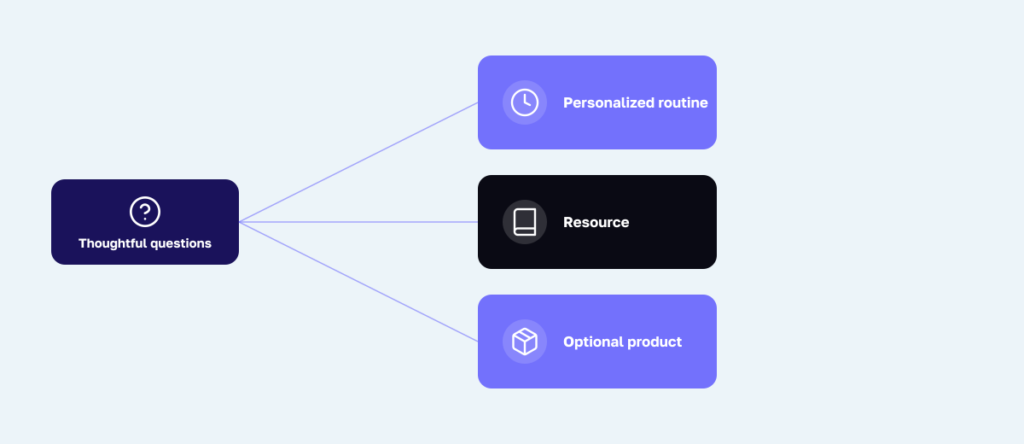
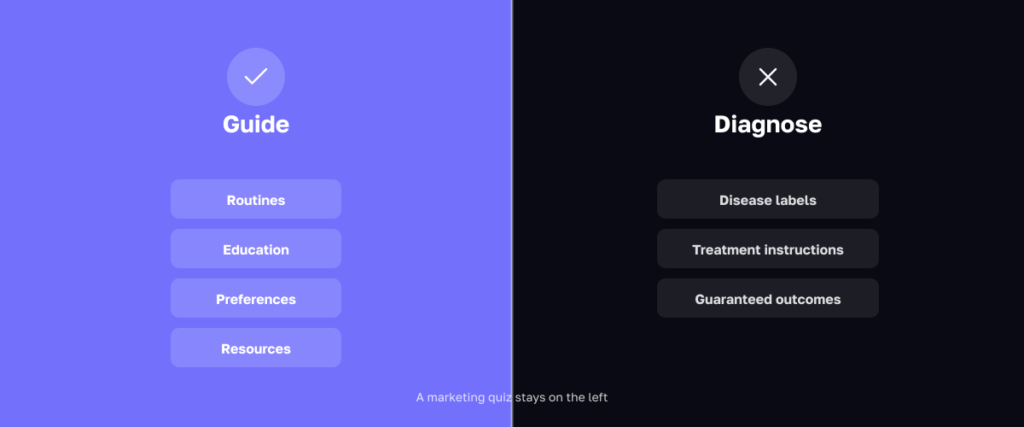
It is also a category where quiz creators have to be careful. A marketing quiz can guide someone toward a routine, resource, class, or product. It should not diagnose a condition, predict a health outcome, or tell someone what treatment they need.
After 13 years of helping companies and experts build quizzes, I have found that the most effective wellness quizzes stay useful and specific without pretending to replace a qualified professional. They organize the creator’s real judgment into a clear next step.
That distinction matters even more in 2026. AI chatbots can summarize common wellness tips instantly. What they cannot reproduce on their own is your experience with your audience, the language your customers use, the patterns in your first-party quiz data, and the resources you have built for a particular person.
This guide shows you how to turn that expertise into a wellness quiz. You will get a complete worked example, 38 questions you can adapt, a step-by-step build process, and practical ways to add lead generation and product recommendations responsibly.
What a wellness quiz should do
A good wellness quiz helps a person make a low-risk decision. It can answer questions such as:
- What type of routine fits my life right now?
- Which meditation style should I try first?
- Which class, article, recipe collection, or program is most relevant to me?
- What kind of accountability would help me follow through?
- Which product format or feature best matches my stated preferences?
The result should feel like a useful starting point, not a verdict. Phrases such as “your answers suggest,” “a practical place to begin,” and “you may want to explore” leave room for context that the quiz does not know.
What a wellness quiz should not do
A general marketing quiz should not tell someone that they have a medical or mental health condition. It should not interpret medications, determine whether a symptom is serious, recommend treatment, or promise that a product will prevent or cure a health problem.
Health claims also need appropriate evidence. The FTC’s Health Products Compliance Guidance explains that health-related advertising claims need substantiation and that important limitations should be clear. A disclaimer does not repair a misleading quiz result or an unsupported product claim.
If your quiz asks about symptoms, diagnoses, medications, fertility, eating disorders, substance use, self-harm, or other sensitive health information, stop before publishing. Get qualified clinical, privacy, security, and legal review. A lead-generation tool is not automatically the right setting for that information.
If someone may need urgent or professional support, direct them to an appropriate qualified professional or emergency resource. Do not make continued quiz completion the path to help.
Start by choosing the job of the quiz
The fastest way to make a wellness quiz confusing is to make it do five jobs at once. Choose one primary decision that the result will help the quiz taker make.
| Quiz job | What it helps someone decide | Example title |
|---|---|---|
| Guided next step | Where to begin | What Kind of Wellness Routine Fits Your Life Right Now? |
| Preference match | Which style or format fits | Which Meditation Style Should You Try First? |
| Readiness or stage | What level of support fits now | What Is Your Best Next Step for Building a Consistent Routine? |
| Resource recommender | Which content, class, or tool to use | Which Five-Minute Practice Matches Your Day? |
| Product recommender | Which low-risk product fits stated preferences | Find Your Ideal Journal Format |
| Knowledge assessment | What the person understands | How Much Do You Know About Building Sustainable Habits? |
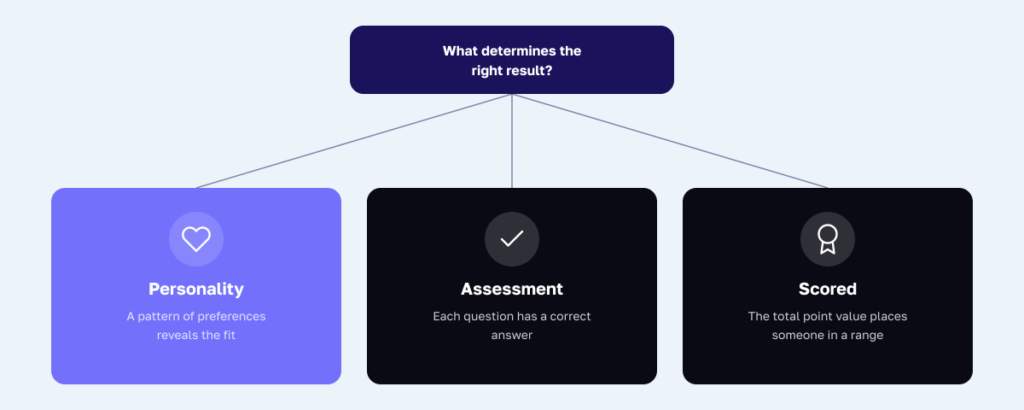
A personality quiz is usually the best format when several answers combine to reveal a preference pattern. A scored quiz works when the score itself has meaning, such as a readiness range. An assessment works when questions have objectively correct answers.
For most wellness lead magnets, I would start with a personality quiz. It lets you provide personal guidance without labeling someone’s health state.
Run the safe-scope test
Before you write outcomes, put the quiz idea through this three-part test.
1. Is the quiz about preferences, context, goals, or habits?
These are usually the strongest inputs for a public wellness quiz. Ask about preferred formats, available time, desired support, current routines, obstacles, and the next step someone wants.
2. Would the result require interpreting symptoms, conditions, or medication?
If yes, the quiz has moved beyond ordinary lifestyle guidance. A qualified professional needs to determine whether the quiz is appropriate, how it should be validated, what data protections it needs, and how users should be supported.
3. How consequential is the recommendation?
Recommending a five-minute breathing audio is different from recommending that someone change medication or delay care. The more consequential the decision, the less appropriate it is for a general marketing quiz.
When in doubt, reduce the quiz’s scope. You can still create a valuable experience by recommending education, preparation, questions to discuss with a professional, or a low-risk first step.
A complete wellness quiz example
Here is the example we will build throughout this guide:
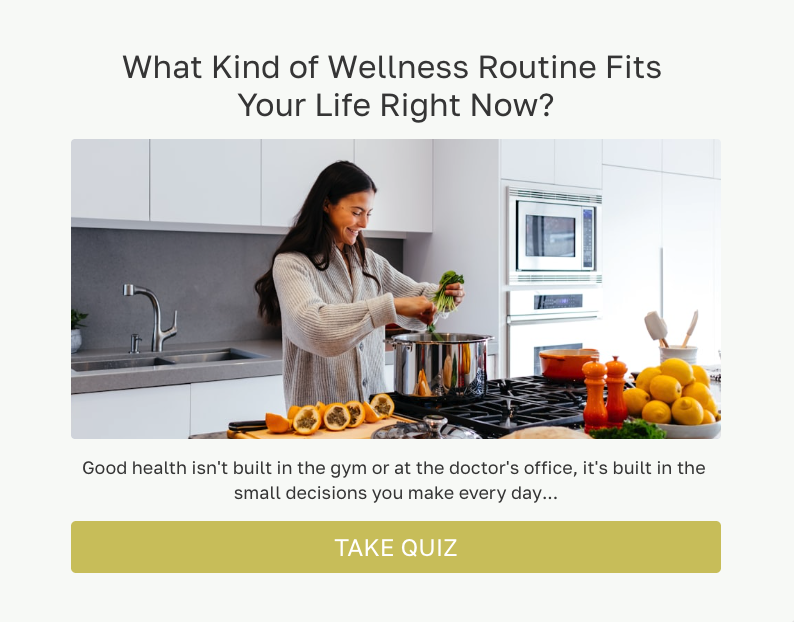
What Kind of Wellness Routine Fits Your Life Right Now?
The quiz does not decide whether the quiz taker is healthy. It identifies the structure most likely to fit the person’s stated preferences and current capacity.
Step 1: Write the outcomes before the questions
Start with four outcomes that are distinct, useful, and easy to act on. If two results would give nearly identical advice, combine them.
The Quick Reset
You want a routine that works in small pockets of time. Short, visible wins are more useful to you than a complicated plan.
Starting point: Choose one practice that takes five minutes or less and attach it to something you already do.
Good recommendations: A short audio, a one-page checklist, a compact kit, or a seven-day mini challenge.
The Steady Ritual
You do best with consistency, a predictable time, and a simple sequence. Repetition helps the routine feel natural.
Starting point: Pick a realistic time and repeat the same small routine for one week before adding anything.
Good recommendations: A habit tracker, recurring class, routine planner, or step-by-step program.
The Guided Practice
You are more likely to begin when someone gives you structure and demonstrates what to do. Expert guidance or community support helps you stay engaged.
Starting point: Choose one guided session and put it on your calendar.
Good recommendations: A beginner class, guided audio series, live workshop, or coaching consultation when appropriate.
The Flexible Menu
Your needs and schedule change from day to day. A small menu of options works better than one rigid routine.
Starting point: Create a short list with a two-minute, ten-minute, and longer option, then choose based on the day you are having.
Good recommendations: A searchable resource library, card deck, varied membership, or choose-your-own-path guide.
These results describe routine fit, not a permanent identity. Say that clearly. A person may get a different result as their schedule or priorities change.
Step 2: Write seven questions that separate the outcomes
Each answer should help distinguish one result from another. Avoid questions that are interesting but do not change the recommendation.
Question 1: When would a wellness practice be easiest to fit into your day?
- In a spare five-minute window. (Quick Reset)
- At the same time each day. (Steady Ritual)
- During a scheduled class or guided session. (Guided Practice)
- Whenever I can choose an option that matches the moment. (Flexible Menu)
Question 2: What usually helps you begin something new?
- Making the first step almost effortless. (Quick Reset)
- Creating a repeatable plan. (Steady Ritual)
- Having someone show me exactly what to do. (Guided Practice)
- Having several appealing choices. (Flexible Menu)
Question 3: Which routine sounds most realistic this week?
- One tiny practice I can finish quickly. (Quick Reset)
- The same simple practice on several days. (Steady Ritual)
- One guided session with clear instructions. (Guided Practice)
- A menu of practices I can choose from each day. (Flexible Menu)
Question 4: What tends to interrupt your routine?
- I feel like I do not have enough time. (Quick Reset)
- I forget or lose momentum. (Steady Ritual)
- I am unsure where to start. (Guided Practice)
- A fixed plan stops fitting my day. (Flexible Menu)
Question 5: How do you prefer to learn a wellness practice?
- A quick prompt I can use immediately. (Quick Reset)
- A written sequence I can repeat. (Steady Ritual)
- A video, audio, teacher, or coach. (Guided Practice)
- A library I can browse based on what I need. (Flexible Menu)
Question 6: Which kind of progress feels most motivating?
- Completing something small today. (Quick Reset)
- Seeing a consistent streak build. (Steady Ritual)
- Feeling more confident with guidance. (Guided Practice)
- Having the right option available at the right time. (Flexible Menu)
Question 7: What would you most like your result to give you?
- One quick action. (Quick Reset)
- A repeatable routine. (Steady Ritual)
- Clear instruction and support. (Guided Practice)
- A flexible set of options. (Flexible Menu)
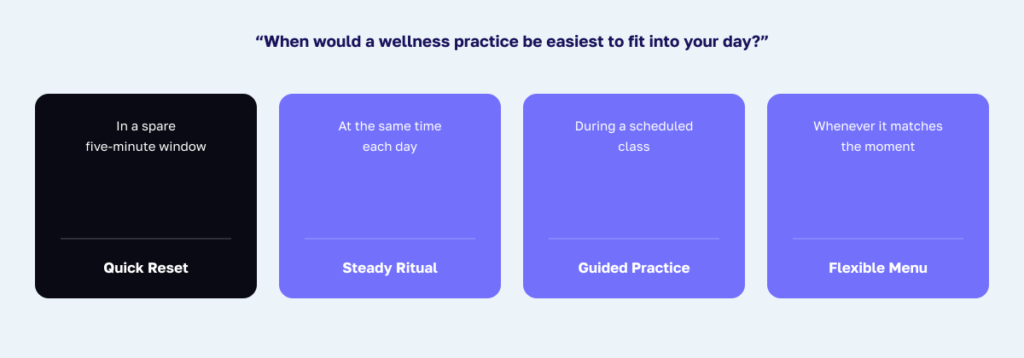
In a personality quiz, connect each answer to the most relevant result. Interact adds one point to a connected result each time that answer is chosen. The result with the strongest correlation becomes the quiz taker’s outcome.
Review the full answer set after you connect it. Every result should have a fair path to win, and no single answer should determine the outcome unless that is intentional and safe.
Step 3: Write a result page that delivers value
Do not make the result a label followed by a sales pitch. A useful result page should include:
- Recognition: what the person told you through their answers
- Meaning: why this approach may fit right now
- Strength: what makes this style useful
- Constraint: what could make it harder to follow
- Next steps: two or three practical actions
- Resource: one relevant guide, class, audio, or product
- Call to action: one clear next move
Here is a short example for The Quick Reset:
Your result: The Quick Reset
Your answers suggest that a short, easy-to-start practice fits your life better than a detailed routine right now. You value progress you can feel today, especially when the first step does not require much preparation.
Your strength is momentum. The common trap is dismissing a small practice because it does not feel ambitious enough. A five-minute routine you repeat is more useful than a 45-minute plan you never start.
Start by choosing one practice that takes five minutes or less. Attach it to a reliable cue, such as finishing lunch or closing your laptop. Try it three times before deciding whether to keep it.
Your next step: Get the Five-Minute Reset audio and checklist.
Important note: This result is educational and based only on your quiz answers. It is not medical advice or a diagnosis. Contact a qualified professional if you have health concerns or need individualized care.
38 wellness quiz questions you can use
Choose only the questions that help determine the result. A short, focused quiz usually creates a better experience than a long intake form. For many marketing quizzes, about seven questions is a useful starting point.
Goals and intent
- Which kind of routine would feel most useful this week?
- What would make this quiz result feel valuable to you?
- Which area of your routine would you like to make more consistent?
- What does a realistic win look like today?
- Which next step are you most interested in exploring?
Current routine and context
- How much time can you realistically set aside on most days?
- When is a new practice easiest to remember?
- Which statement best describes your current routine?
- Where are you most likely to use this practice?
- What usually gets in the way of following through?
- How much planning do you want your routine to require?
- Which existing habit could serve as a reminder?
Preferences
- Do you prefer a quiet solo practice or a shared experience?
- Would you rather follow one routine or choose from a menu?
- Which format do you enjoy most: reading, audio, video, or live guidance?
- Do you prefer a quick prompt or a detailed explanation?
- Which environment helps you focus?
- Do you enjoy tracking progress or keeping the experience unmeasured?
- Which pace feels most natural: gentle, steady, or energetic?
Capacity, environment, and support
- How much setup feels manageable?
- What level of structure helps you follow through?
- Would reminders make the practice easier to continue?
- Which kind of support would you use: self-guided, group, or one-to-one?
- How often do you want a new activity or prompt?
- Which obstacle should your recommendation work around?
Readiness and next step
- How ready are you to try one small change this week?
- Would you rather start now or make a simple plan first?
- What would make a first step feel low pressure?
- Which commitment feels realistic for the next seven days?
- What kind of accountability would you welcome?
- After seeing your result, what would you most likely do next?
Product and resource fit
- Which resource would you actually use: checklist, audio, video, planner, or live class?
- Do you prefer a digital resource or a physical one?
- Which feature matters most: simplicity, variety, portability, or guidance?
- Are you looking for a free starting point or a more complete paid option?
- How much customization do you want?
- Would you rather explore on your own or receive a recommended path?
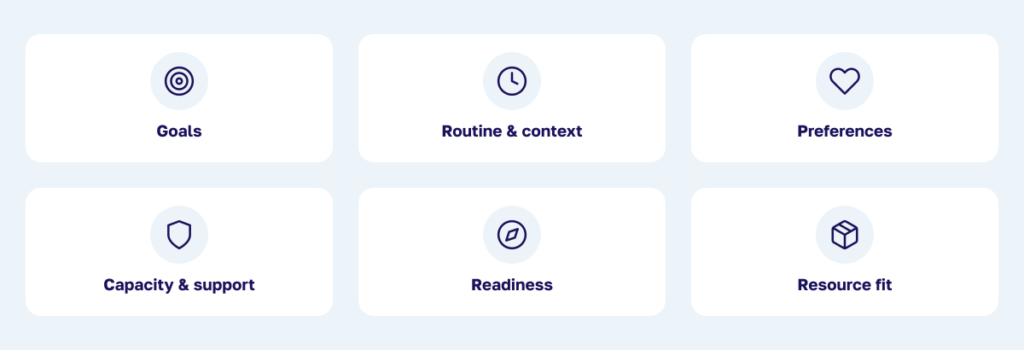
You do not need all 38. Treat this as a question bank. Select six to eight questions that create the clearest separation between your outcomes.
Questions to avoid, and how to rewrite them
Some questions collect more sensitive information than the recommendation requires. Others push the quiz toward diagnosis or treatment. Use the least sensitive question that can still produce a useful result.
| Avoid this | Why it is risky | Safer direction |
|---|---|---|
| Which condition do you probably have? | Asks the quiz to diagnose | Which educational topic or resource would you like to explore? |
| Is your fatigue caused by a hormone problem? | Interprets a symptom and suggests a cause | What time of day would a short routine fit best? |
| Which supplement will cure your symptoms? | Makes a treatment and cure claim | Which product format best matches your stated preferences? |
| How severe is your depression? | Sensitive clinical territory | What type of general support would you like to learn about? Add direct professional resources when relevant. |
| Should you stop taking your medication? | Consequential medical advice | What questions would you like to prepare for a conversation with your clinician? |
| What is wrong with your body? | Judgmental and vague | What would you like your routine to help you do more consistently? |
| Are you failing at self-care? | Uses shame to force a result | Which obstacle makes a routine harder to maintain? |
The safer version may be less dramatic, but it is often more useful. It asks for information the quiz can responsibly act on.
How to build the wellness quiz in Interact
1. Create the four results
Open Interact and choose a personality quiz for the worked example. You can start from a template or use the Interact AI quiz maker to create a first draft.
AI is useful for structure, but the creator still needs to supply the judgment. Replace generic result language with your audience’s words, your examples, and the next steps you would recommend in a real conversation.
2. Add six to eight questions
Keep one decision in view. If a question would not change the result or the follow-up, remove it.
Use text questions by default. Images can help when the visual difference is part of the preference, such as choosing a journal layout, room setup, movement style, or product design. Add descriptive text and do not rely on color alone.
Image questions, image answers, and a combination of both can make a wellness quiz more inviting. The key is to use visuals as information, not decoration. Avoid before-and-after body imagery, fear-based symptom imagery, or pictures that pressure people to judge their bodies.
3. Connect every answer to a result
Select a question, open Result Correlations, and connect each answer to the outcome it supports. Interact’s result correlation guide shows the current workflow.
Read the quiz once from the perspective of each result. Make sure there are several reasonable paths to that outcome and that the answer wording does not make one choice look obviously better than the others.
4. Build each result page
Use the seven-part structure from this guide: recognition, meaning, strength, constraint, next steps, resource, and call to action. Interact supports a different call-to-action button on each result page, so the destination can match the outcome.
5. Preview and test every path
Take the quiz several times using intentionally different answer patterns. Ask a colleague or customer to explain what they think each question means. Rewrite anything that feels confusing, judgmental, intrusive, or too certain.
6. Publish and share
Publish the quiz, then use the live quiz link on your website, in email, in social posts, or anywhere your audience already asks the question your quiz answers.
Add lead generation without hiding the value
For most wellness quizzes, place the email opt-in immediately before the result. By that point, the person understands what they are getting and has invested enough attention to want the answer.
Explain exactly what happens after someone submits the form. For example: “Enter your email to see your routine type and get your matching five-minute guide.” Link to your privacy notice and make any ongoing marketing consent clear.
Ask only for fields you will use. An email address and perhaps a first name are often enough. Do not collect sensitive health details simply because the form makes it possible.
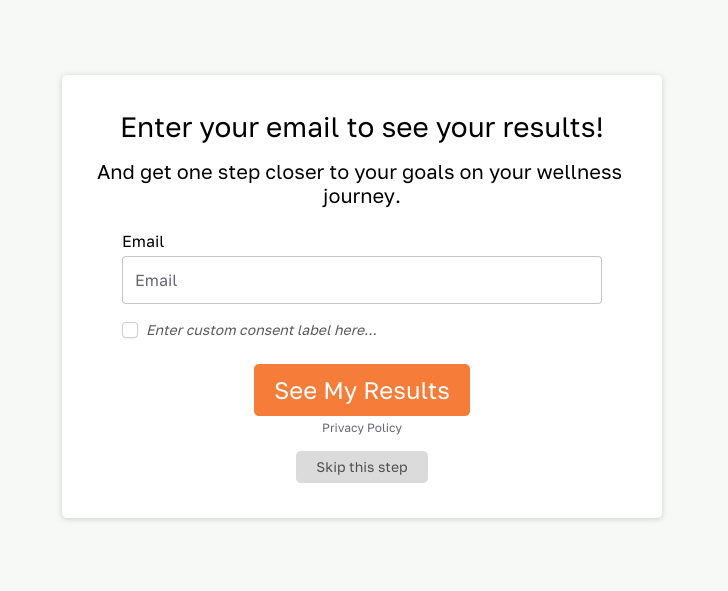
An optional opt-in may be the better choice when the subject is personal or the business wants to prioritize trust. Interact customer The Habit Ayurveda has used an optional opt-in in a quiz taken nearly 600,000 times, with more than 170,000 people choosing to subscribe. Those figures describe that customer’s experience, not a guaranteed benchmark for every wellness quiz. You can read the full customer story.
After the quiz, tag or segment each subscriber by result. Send the result right away, along with one useful resource that matches it. Then continue with a small sequence that expands the recommendation instead of repeating the same pitch to everyone.
A simple follow-up can be:
- Email 1: Deliver the result and the promised resource.
- Email 2: Explain the common obstacle for that result and one way around it.
- Email 3: Share a relevant customer story, lesson, or behind-the-scenes example.
- Email 4: Invite the person to the next logical class, product, program, or conversation.
The exact number and timing of emails should fit the offer and the consent you received. The principle is more important than the sequence: continue the personalized guidance the quiz started.
Add product recommendations responsibly
A wellness product recommendation should follow from the person’s answers. It should not appear because it has the highest margin or because the result page needs something to sell.
Start by mapping each result to a need the quiz can actually observe. The Quick Reset might value portability and low setup. The Guided Practice might value instruction. Those are supportable preference matches.
Do not use a general marketing quiz to recommend that someone begin, stop, or change a medical treatment. Be especially careful with supplements and products tied to disease, symptom, weight-loss, hormone, fertility, or mental health claims. Claims in the quiz, result page, product page, and follow-up email all need appropriate substantiation.
| Result | Observed preference | Free resource | Paid next step |
|---|---|---|---|
| Quick Reset | Short and easy to start | Five-minute audio | Compact starter kit |
| Steady Ritual | Repeatable structure | Weekly routine planner | Guided habit program |
| Guided Practice | Instruction and support | Beginner video | Live class or appropriate consultation |
| Flexible Menu | Variety and choice | Practice menu | Resource library membership |
Give one primary recommendation and explain why it fits. If you add alternatives, distinguish them by budget, format, or level of support. Too many choices weaken the value of the quiz.
Three wellness quiz examples worth studying
Kelly Smith: Help people choose from a large content library
Kelly Smith of Yoga For You created the Find Your Meditation Match quiz to answer a practical question: which meditation should I start with? The quiz uses about eight questions to guide people toward a relevant meditation from a library of hundreds of podcast episodes.
This is a durable quiz strategy because it helps the audience navigate expertise that already exists. The recommendation is useful immediately, and the quiz gives Kelly better context for future communication. Read the Kelly Smith customer story.
The Habit Ayurveda: Make a complex framework easier to enter
Carly Banks used a quiz to give a large audience a personalized entry point into her company’s wellness content and offers. Nearly 600,000 people have taken the quiz and more than 170,000 have opted in. Read the Interact customer story.
The useful lesson is not to copy another creator’s health claims or framework. It is to make a complex body of expertise easier to navigate and to let people choose whether to continue the relationship.
Dr. Sasha Hamdani: State the boundary clearly
Qualified experts can use a quiz as an educational starting point while clearly stating that the result is not a diagnosis. In our guide to turning expertise into a quiz, Dr. Sasha Hamdani is an example of that non-diagnostic framing.
That boundary increases trust. The quiz can help someone recognize a topic, prepare questions, or find an educational resource while directing diagnosis and treatment to an appropriate professional.
Protect the quiz taker’s privacy
Do not treat “HIPAA compliant” as a general synonym for private or secure. HIPAA applies to covered entities and business associates in specific circumstances, as explained by the U.S. Department of Health and Human Services. Some consumer wellness businesses and apps fall outside that scope, but other privacy, consumer-protection, contract, and security obligations may still apply.
HHS also notes that health information entered into a personal app may not be protected by HIPAA unless the app is provided by a covered entity or business associate. Its mobile health app resources can help businesses begin identifying which federal rules may apply.
For a public wellness quiz, use these defaults:
- Collect the least sensitive information needed for the recommendation.
- Explain why you collect it and how you will use it.
- Link to a clear privacy notice before submission.
- Limit who can access response data.
- Set a retention and deletion policy.
- Review analytics, pixels, and other tracking tools before using them on health-related pages.
- Get qualified privacy, security, and legal review when the quiz handles identifiable health information.
If a covered entity or business associate plans to handle electronic protected health information with a cloud service provider, HHS explains that the relationship may require a compliant business associate agreement and other safeguards. Review the HHS cloud computing guidance with qualified counsel.
Use language that leaves room for the person
Wellness results work best when they are confident about the recommendation and modest about what the quiz knows.
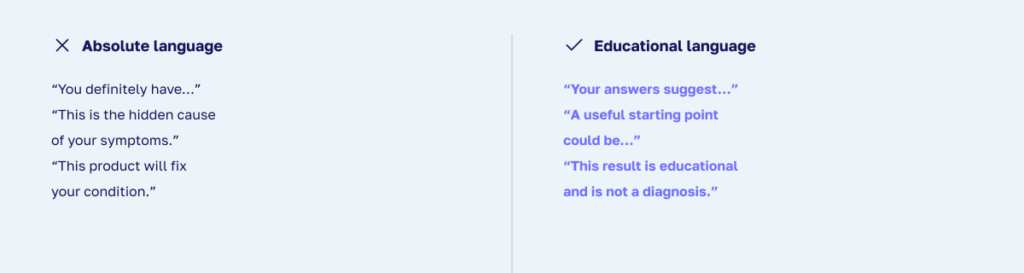
Use phrases such as:
- Your answers suggest that this routine structure may fit your current schedule.
- A useful starting point could be…
- Based on the preferences you selected…
- You may want to explore…
- If this concern affects your health or safety, contact a qualified professional.
- This result is educational and is not a diagnosis or treatment recommendation.
Avoid phrases such as:
- You definitely have…
- This is the hidden cause of your symptoms.
- This product will fix your condition.
- You do not need to see a professional.
- If you do not act now, your health will get worse.
Test the quiz before sending traffic
Testing is not only about buttons and links. Ask whether the quiz delivers the right recommendation to different people and whether it does so without collecting unnecessary information.
Before launch:
- Complete every plausible result path.
- Confirm that every answer maps to the intended result.
- Check the quiz on a phone and a desktop.
- Test the opt-in, privacy link, tags, email delivery, and result-specific call to action.
- Ask people from the intended audience what felt unclear, intrusive, or judgmental.
- Ask a qualified reviewer to examine any health-related claims or sensitive questions.
- Confirm that urgent-support language is direct and accessible where relevant.
After launch, use Interact’s quiz analytics to watch starts, completions, opt-ins, and result distribution. A result that almost never appears may need better answer coverage. A question with high abandonment may be confusing, too personal, or poorly placed.
The response data also becomes part of your durable content advantage. Look for recurring goals, obstacles, preferred formats, and audience language. Use those patterns to improve the quiz and create articles, classes, and products that answer real customer needs. Report trends in aggregate rather than exposing individual responses.
Wellness quiz FAQ
How many questions should a wellness quiz have?
Start with about seven. Use enough questions to distinguish the outcomes, but remove anything that does not affect the result or follow-up. A complex clinical instrument is a different type of project and should not be disguised as a short marketing quiz.
Should I require an email before showing the result?
You can, but the value exchange and consent should be clear. An optional opt-in can be appropriate for a personal topic. If you require an email, tell people what they will receive, link to your privacy notice, and avoid asking for sensitive information you do not need.
Can a wellness quiz recommend products?
Yes, when the recommendation is based on low-risk preferences or goals and the claims are accurate and substantiated. Do not use a general marketing quiz to diagnose a condition or prescribe treatment.
Can I ask about symptoms?
Symptoms move the quiz into higher-risk territory. Do not assume a disclaimer makes the question safe. Get qualified clinical, privacy, security, and legal review before collecting or interpreting symptom information, and consider whether a marketing quiz is appropriate at all.
Is every wellness quiz covered by HIPAA?
No. HIPAA applies to covered entities and business associates in defined circumstances, not automatically to every wellness company or app. Other rules and obligations may still apply. Get advice for your specific business, data, users, and location.
Should I use images in a wellness quiz?
Use them when the image communicates a real option, such as a layout, setting, product style, or activity format. You can use an image question, image answers, or both together. Include accessible descriptions and avoid imagery that is shaming, fear-based, or medically misleading.
Build a quiz that earns the next conversation
The best wellness quiz does not try to solve a person’s health in seven clicks. It answers one useful question, recommends a realistic next step, and makes the boundary of that recommendation clear.
Start with four outcomes. Write about seven questions that distinguish them. Deliver the result before you ask for too much, and make every resource, email, and product recommendation follow from what the person told you.
That is how a wellness quiz remains valuable in 2026. It combines your experience, your customer language, and your unique audience data into guidance that a generic answer engine cannot create for your business.
You can start building a wellness quiz with Interact and use the routine-fit example in this guide as your first draft.